

2025 Annual Security Report & Fire Safety Report
To print this document, open your browser’s file menu and choose “print.”
Table of Contents
- A MESSAGE FROM THE CHIEF OF PUBLIC SAFETY
- NOTICE OF NON-DISCRIMINATION
- POLICY FOR REPORTING A CRIME OR EMERGENCY TO THE OFFICE OF PUBLIC SAFETY
- CRIMINAL OFFENSES – Jurisdiction and Adjudication
- POLICY FOR REPORTING THE ANNUAL DISCLOSURE OF CRIME STATISTICS
- CRIME STATISTICS FOR INCLUSION IN THE ASR
- TIMELY WARNING POLICY – Crime Alerts
- PREVENTING AND RESPONDING TO SEXUAL MISCONDUCT, SEXUAL ASSAULT, INTIMATE PARTNER VIOLENCE, AND STALKING
- POLICY STATEMENT ON SEXUAL MISCONDUCT
- I. POLICY STATEMENT
- II. NOTICE OF NON-DISCRIMINATION
- III. REPORTING AND PRIVACY
- IV. SUPPORTIVE MEASURES
- V. RETALIATION
- VI. OTHER RECOMMENDED ACTIONS FOLLOWING AN INCIDENT
- VII. DEFINITION OF KEY TERMS
- VIII. POLICY DEFINITIONS
- IX. SUPPORTING DEFINITIONS – TITLE IX AND NON-TITLE IX
- X. REPORTING AND OTHER RESOURCES
- XI. “OFFICIALS WITH AUTHORITY” (AS DEFINED IN THIS POLICY)
- XII. PREVENTION AND AWARENESS PROGRAMS AND TRAINING
- XIII. RELATED POLICIES, SOURCES, AND INFORMATION
- INFORMATION ON REGISTERED SEX OFFENDERS
- CHILD ABUSE OR NEGLECT REPORTING POLICY AND CODE OF CONDUCT
- HAZING POLICY STATEMENT
- NEW AND ONGOING AWARENESS, PREVENTION, BYSTANDER INTERVENTION, AND RISK-REDUCTION PROGRAMS, TRAININGS, AND INITIATIVES ON POLICY AND CRIME – INCLUDING SEXUAL ASSAULT, INTIMATE PARTNER VIOLENCE, AND STALKING
- EMERGENCY PROCEDURES GUIDE FOR RESPONDING TO ACTIVE THREATS
- EMERGENCY NOTIFICATION POLICY
- EMERGENCY RESPONSE AND EVACUATION PROCEDURES AND DRILLS
- EMERGENCY MANAGEMENT DRILLS
- MULTI-HAZARD EMERGENCY MANAGEMENT: SAFETY AND EMERGENCY RESPONSE COMMITTEE FOR POLICY, TRAINING, AND RESPONSE
- GENERAL SAFETY GUIDELINES
- OFF-CAMPUS TRANSPORTATION
- OFF-CAMPUS SHUTTLE SERVICES
- ACCESS TO CAMPUS BUILDINGS POLICY
- SECURITY OF AND ACCESS TO FACILITIES, INCLUDING RESIDENCE HALLS, FOR MAINTENANCE POLICY
- SAFETY IN THE RESIDENCE HALLS
- DAILY CRIME AND FIRE LOG
- MISSING STUDENT POLICY
- POLICIES GOVERNING ALCOHOL AND OTHER DRUGS
- WEAPONS POLICY
- CLERY ACT CRIME DEFINITIONS
- CRIME STATISTICS
- FIRE SAFETY REPORT – REGULATIONS
- FIRE EVACUATION
- GENERAL EVACUATION AND PROCEDURES
- EVACUATION OF PERSONS WITH DISABILITIES
- FIRE SAFETY EDUCATION
- PROVIDENCE COLLEGE ANNUAL DISCLOSURE AND SUMMARY OF FIRE STATISTICS
- APPENDIX A: Student Conduct Code – Disciplinary Sanctions
- APPENDIX B: Maps – Clery Geography
Including 2022-2023-2024 Campus Crime Statistics
A MESSAGE FROM THE CHIEF OF PUBLIC SAFETY
Chad Carnegie
Chief of Public Safety
On behalf of the men and women of the Providence College Office of Public Safety, I want to welcome you to the Annual Security Report. The Office of Public Safety’s mission statement is to safeguard members of the College community, to protect private and institutional property, and to prevent crime.
Our priority is to safeguard the Providence College campus to ensure a safe space for all community members. Members of the community share this responsibility and are expected to help The Office of Public Safety identify and report behavior that constitutes a violation of College policy and/or criminal law, and to take reasonable safety precautions.
The Jeanne Clery Disclosure of Campus Security Policy and Campus Crime Statistics Act, 20 U.S.C. § 1092(f) (“Clery Act”), is a federal law requiring colleges and universities that receive federal financial assistance to disclose annually (by October 1) certain information about campus crime, and safety and security policies to current and prospective students and employees. This Annual Security and Fire Safety Report contains crime and fire statistics for the three previous calendar years and information on safety and security, campus law enforcement, crime prevention and reporting, fire safety, disciplinary procedures, and educational programs, services and resources. This Report is available here. Print copies of this Report are available in the Office of Public Safety, the Office of Undergraduate Admissions, and the Office of Human Resources.
NOTICE OF NON-DISCRIMINATION
Providence College admits students of any race, color, national and ethnic origin, sex, gender, sexual orientation, gender identity, religion, disability, age, or veteran status, and without regard to genetic information, to all the rights, privileges, programs, and activities generally accorded or made available to students at the College. It does not discriminate on the basis of race, color, national and ethnic origin, sex, gender, sexual orientation, gender identity, religion, disability, age, veteran status, genetic information, or any other applicable legally protected basis, in the administration of its education policies, admission policies, scholarship and loan programs, athletic and other College-administered programs, and employment policies. In accordance with Title IX, it does not discriminate on the basis of sex and prohibits sex discrimination in its educational programs or activities. Nothing in this Notice shall require Providence College to act in a manner contrary to its Dominican mission and the teaching and tenets of the Catholic Church, and the College reserves the right to take actions designed to ensure and promote its Catholic and Dominican mission.
Inquiries regarding the application of this Notice of Non-Discrimination and Providence College’s non-discrimination policies may be directed as follows:
The Equal Employment Opportunity Coordinator, Coordinator of the Age Discrimination Act of 1975, and Americans with Disabilities Act/Section 504 of the Rehabilitation Act of 1973 Coordinator, is:
- Senior Associate Vice President for Human Resources (Mirlen A. Mal, Harkins 302, 401-865-2430, mmal@providence.edu)
Inquiries regarding ADA/Section 504 issues for students may also be directed to:
- Assistant Dean/Director of Accessibility Services (Jonathan A. Gomes, Library 216, 401-865-2470, jgomes3@providence.edu); and
- Associate Vice President of Student Affairs/Associate Dean of Students (Tiffany D. Gaffney, Slavin 201, 401-865-2191, tgaffne1@providence.edu)
The Coordinator of Title IX of the Education Amendments of 1972 is:
- Assistant Vice President for Institutional Diversity and Equity Compliance (Simone N. Tubman, Harkins 312, 401-865-2878, stubman@providence.edu)
The Title IX Coordinator is assisted by deputy coordinators, including members of the faculty and the administration (https://equity-compliance.providence.edu/policy-resolution-process/).
Concerns about the College’s application of Title IX can be made externally to:
- Assistant Secretary for Civil Rights, U.S. Department of Education, Office for Civil Rights, 400 Maryland Avenue SW, Washington, DC 20202-1100, Telephone: 800-421-3481
- Regional Office for Civil Rights, U.S. Department of Education, 400 Maryland Avenue, SW, Washington, D.C. 20202-1475; Telephone: 202-453-6020
- Equal Employment Opportunity Commission (EEOC); Contact: https://www.eeoc.gov/field-office/boston/location
The Coordinator of the College’s Anti-Harassment and Discrimination Policy and Title VI of the Civil Rights Act is:
- Assistant Vice President for Institutional Diversity and Equity Compliance (Simone N. Tubman, Harkins 312, 401-865-2878, stubman@providence.edu)
POLICY FOR REPORTING A CRIME OR EMERGENCY TO THE OFFICE OF PUBLIC SAFETY
The Providence College Office of Public Safety is located on the main campus at the Huxley Avenue gate,
providing service to the campus community 24 hours a day, 7 days a week, 365 days a year. The office is
staffed by the Chief of Public Safety, the Deputy Chief of Public Safety, the Patrol Captain, one (1)
lieutenant, five (5) sergeants, twenty-three (23) officers, one (1) investigator, one (1) administrative
coordinator, and five (5) dispatchers /switchboard operators. Under the auspices of the Sr. Vice President
of Student Affairs, the Office of Public Safety works closely with the Providence College Safety and
Emergency Response Committee and the Clery Act Compliance Committee, as well as with the Providence Police
Department, to create a safe and secure campus environment. In an effort to accomplish this goal, the office
provides motor, bike, and foot patrols on campus.
The Providence College Annex, located at 231 Douglas Avenue, Providence, RI, is an off-campus property for which crime activity is monitored and reported. The Annex is intended to be a space for campus/community dialogue and collaboration. It supports immediate, short-term initiatives such as discussions, exhibitions, and meetings. It also supports courses, workshops, retreats for campus and community groups, and ongoing projects that serve the community. Off-campus College-owned and leased housing is also monitored for crime activity and reporting. For purposes of the Clery Act, Non-College-Owned, Leased Student Housing is considered to be within the College’s campus geography. (Please see Maps in Appendix B).
Providence College strongly encourages the prompt and accurate reporting of all criminal or suspicious activities occurring on or near campus. Reports can be made by calling or visiting the Office of Public Safety, by speaking with an officer on patrol, or by communicating with a member of the residence life staff. Persons who prefer not to report alone may be supported by the presence of a friend. Students and employees may report a crime by contacting a member of the community who serves as a resource for them. Once a report is received, it will be evaluated, and appropriate action will be taken. Reports to the Office of Public Safety may form the basis of criminal charges (violations of state and federal laws) or disciplinary matters (violations of College policy). As warranted, the Office of Public Safety will work and cooperate with the Providence Police Department and the Rhode Island State Police. Crime victims also may file criminal reports directly with the Providence Police Department at its office complex in Providence, R.I., or by calling (401) 272-3121. Complaints made to the Providence Police Department are investigated by the department and referred to the state attorney general’s office for prosecutorial decisions.
Anonymous Crime Reporting – Silent Witness Program
Reports of and/or information about crimes that occur on campus—including but not limited to assaults, vandalism and thefts—also may be reported to the Silent Witness Program via the Web page of the Office of Public Safety https://safety.providence.edu/silent-witness/). Reporters may identify themselves or remain anonymous. When reporters who identify themselves request privacy (i.e., that the College refrain from disclosing their identity) during any investigation, the College will make every reasonable effort to honor that request and to maintain the level of privacy requested. When reporters remain anonymous, the ability of the College to respond to the report or to pursue appropriate action against the alleged perpetrator(s) may be negatively affected. Information about an incident may be disclosed (i.e., nature, date, and location of the incident) in the form of safety announcements, summary report updates, or as required by law. For an emergency needing an immediate response call 911 OR 401-865-2222.
Crime Reporting by Campus Security Authorities (“CSAs”)
A school official with significant responsibility for student and campus activities – referred to as a CSA – is required to report incidents of alleged campus crime to the College’s Office of Public Safety for review by the Clery Act Coordinator. CSAs include the following categories of employees: public safety; deans; student affairs and administration, including residence life, student conduct, student health; athletics administrators and team coaches; human resources; faculty advisors and moderators to clubs, organizations, and other types of College-sponsored student groups; and, faculty and staff who lead and/or supervise short- or long-term College-sponsored trips. Personally identifiable information is kept confidential (unless the victim agrees to release it); the type, date, time, and general location (on or immediately adjacent to campus, or on property owned or controlled by the College) of the incident is released for publication in the Annual Security Report and the Crime Log. Additionally, statistical campus crime data is reported to the federal government, specifically the U.S. Department of Education.
Confidential Crime Reporting – Pastoral and Professional Counselors
A pastoral counselor is defined as an employee who is associated with a religious order or denomination recognition as someone who provides confidential counseling and who is functioning within the scope of that recognition as a pastoral counselor. “A professional counselor is defined as an employee whose official responsibilities include providing psychological counseling to members of the institution’s community and who is functioning within the scope of his or her license or certification, including professional counselors who are under contract to provide counseling, and those who are not yet licensed but are acting as a professional counselor under the supervision of an individual who is licensed or certified. (An example is a Ph.D. counselor-trainee acting under the supervision of a professional counselor at the institution.)
Crimes reported to pastoral or professional counselors are not required to be reported by an institution under the Clery Act; however, as a matter of policy, these counselors are encouraged, if and when deemed appropriate, to inform persons being counseled of the procedures to report crimes on a voluntary and confidential basis so that incidents of crime that are reported exclusively to professional and pastoral counselors will be included in the annual crime statistics if they occurred within the Clery Act geography.
CRIMINAL OFFENSES – Jurisdiction and Adjudication
Although the Providence College Office of Public Safety does not possess the power to arrest, Public Safety assists law enforcement in their investigations. When Providence Police are called to take a criminal report by the Providence College Office of Public Safety, the Providence Police has jurisdiction in the matter. If the Providence Police make an arrest and the suspect is a student or employee, he/she not only may be charged for the offense in the legal system, but also via the applicable College disciplinary system.
POLICY FOR REPORTING THE ANNUAL DISCLOSURE OF CRIME STATISTICS
The information contained in this Report is provided as an integral part of Providence College’s commitment to safety and is compliant with the federal Student Right-to-Know and Campus Security Act of 1990, Public Law 101-542, as amended into the Jeanne Clery Act of 1998. This publication, which is provided to all employees, and to students registered as of August 31, 2025, is available at https://safety.providence.edu/. Additional copies are available upon request at the Office of Public Safety, the Office of Undergraduate Admission, and the Office of Human Resources. If you have any questions regarding the content of this publication, please contact Eric Croce, Deputy Chief of Public Safety, at 401-865-2391.
The Office of Public Safety compiles crime statistics, which are included in this Report, in compliance with the Jeanne Clery Act. Additionally, the Office of Public Safety maintains a daily crime log listing the case number, nature, date, time, and general location of each crime and the disposition of the complaint, if known.
Pursuant to the Jeanne Clery Act, the U.S. Department of Education requires all school officials with “significant responsibility for student and campus activities” – designated as Campus Security Authorities – to report incidents of alleged campus crime to the College’s Office of Public Safety.
Student-victims of crime have the option to seek confidential assistance from the Office of the Chaplain and the Personal Counseling Center. The College is not required to include crimes reported only to a pastoral or professional counselor in the crime statistics published in this report. Students who seek personal counseling or pastoral counseling on campus are advised that if they share information regarding the commission of an offense that the counselor believes poses a direct threat to a member of the community or others, information may be released to appropriate authorities and other persons. Appropriate authorities and other persons may include College administrators, a parent/guardian, medical personnel, and police officials. Whether or not, and to whom, to release information will depend on the particular circumstances of the incident.
The College compiles its crime statistics using the uniform crime reporting system of the Department of Justice, Federal Bureau of Investigation, including any modifications pursuant to the Hate Crime Statistics Act. Please note that crime statistics are based on incidents reported. A criminal incident is reported when it is brought to the attention of the Office of Public Safety or the local police by a victim, witness, campus security authority, or other third party. The primary source for statistics is reports received by the College’s Office of Public Safety. Crime statistics, for Jeanne Clery Act purposes, include all reports regardless of their investigative status or result.
CRIME STATISTICS FOR INCLUSION IN THE ASR
Clery Act Geographic Definitions
The College’s crime statistics for the Annual Security Report (“ASR”) are compiled from reports of crimes from police, from CSAs, or from any credible source. Statistics for certain types of crimes, such as sexual offenses, may not be a true reflection of their occurrence due to underreporting. Statistics are included for reports of crimes that have occurred at any of the following locations:
On-Campus – A building or property owned or controlled by the College.
Residence Halls – A subset of “on-campus, any student housing facility that is owned or controlled by the College, or is located on property that is owned or controlled by the College.
Public Property – Public property that is within the campus or immediately adjacent to and accessible from the campus.
Non-Campus – Any building or property owned or controlled by a student organization that is officially recognized by the College (Providence College does not have any officially recognized student organizations with non-campus locations). Any building or property owned or controlled by the College, used in direct support of the College’s educational purposes, and frequently used by students.
TIMELY WARNING POLICY – Crime Alerts
In the event that campus public safety or local law enforcement authority receives a report of a crime (in accordance with the F.B.I. definitions of crime categories), and the commission of the crime within the Clery Act geography constitutes a serious or ongoing threat to the campus community, a campus-wide, timely warning in the form of a “Crime Alert” will be issued in an email message to students, faculty, and staff. The purposes of the timely warning are to alert the campus community to the occurrence of a crime that poses an ongoing threat and to heighten student and employee safety awareness in a manner that will aid in the prevention of similar crimes. The email will identify that a Crime Alert has been issued, provide pertinent information regarding the incident, and may provide information about safety-awareness tips. The email will not identify the name of the victim.
In accordance with the Jeanne Clery Act, determinations about whether and when to issue warnings will be made by the Chief of Public Safety, or his designee, on a case by case basis in light of all the facts surrounding a crime, including factors such as the nature of the crime, the continuing danger to the campus community, the availability of accurate information, and the possible risk of compromising law enforcement efforts. Depending on the particular circumstances of the crime, the Office of Public Safety may provide expanded notice in accordance with the College’s emergency notification policies and procedures. Anyone with information warranting a timely warning should report the circumstances to the Office of Public Safety.
Crimes that might constitute a continuing or serious threat include but are not limited to: serial crimes that target certain campus populations, such as sex-based or race-based crimes in which the offender has not been apprehended; and ongoing criminal activity in which there is no apparent connection between offender and victim. Crimes that would not constitute a continuing or serious threat include but are not limited to: crimes for which a threat has been eliminated because the offender has been apprehended or because the known offender has targeted specific persons to the exclusion of others (such as domestic violence). These vague scenarios are illustrative only; for purposes of determining whether to issue a Crime Alert, each report will be assessed based on relevant and reliable information available at the time.
Safety Advisories or Community Notifications (Non-Clery Act Notification to the Community)
The Office of Public Safety occasionally receives reports of crimes that are not Clery-Act crimes and/or that occurred at locations outside the Clery geography; thus, a Timely Warning-Crime Alert will not be issued. The Chief (or designee) may determine that there is a serious or continuing threat to students and employees and may issue a “Safety Advisory” or “Community Notification” to the College community or to particular populations within the community. Although safety advisories and notifications are not required under the Clery Act, they are consistent with the Office of Public Safety’s mission to promote awareness and prevention about known or suspected safety risks on or near campus.
PREVENTING AND RESPONDING TO SEXUAL MISCONDUCT, SEXUAL ASSAULT, INTIMATE PARTNER VIOLENCE, AND STALKING
RHODE ISLAND CRIMINAL LAW DEFINITIONS
The following state definitions are informational and are not used to classify crime statistics in the Providence College Annual Security Report.
First degree sexual assault. A person is guilty of first-degree sexual assault if he or she engages in sexual penetration with another person, and if any of the following circumstances exist: (1) The accused knows or has reason to know that the victim is mentally incapacitated, mentally disabled, or physically helpless. (2) The accused uses force or coercion. (3) The accused, through concealment or by the element of surprise, is able to overcome the victim. (4) The accused engages in the medical treatment or examination of the victim for the purpose of sexual arousal, gratification, or stimulation. R.I.G.L. § 11-37-2
Second degree sexual assault. A person is guilty of a second-degree sexual assault if he or she engages in sexual contact with another person and if any of the following circumstances exist: (1) The accused knows or has reason to know that the victim is mentally incapacitated, mentally disabled or physically helpless. (2) The accused uses force, element of surprise, or coercion. (3) The accused engages in the medical treatment or examination of the victim for the purpose of sexual arousal, gratification, or stimulation. R.I.G.L. § 11-37-4
Third degree sexual assault. A person is guilty of third-degree sexual assault if he or she is over the age of 18 years and engaged in sexual penetration with another person over the age of 14 years and under the age of consent, 16 years of age. R.I.G.L. § 11-37-6
Domestic abuse. The occurrence of one or more of the following acts between present or former family members, parents, stepparents, a plaintiff parent’s minor child(ren) to which the defendant is not a blood relative or relative by marriage, adult persons who are or have been in a substantive dating or engagement relationship within the past one year and who are (either individually or together) parents of minor children, or persons who are or have been in a substantive dating or engagement relationship within the past one year in which a least one of the persons is a minor:(i) Attempting to cause or causing physical harm; (ii) Placing another in fear of imminent serious physical harm; or (iii) Causing another to engage involuntarily in sexual relations by force, threat of force, or duress. (iv) Stalking or cyber-stalking.R.I.G.L. § 15-15-1(4)
Substantive dating or engagement relationship. A significant and personal/intimate relationship that shall be adjudged by the court’s consideration by the following factors: (i) The length of time of the relationship; (ii) The type of relationship; and (iii) The frequency of interaction between the parties. R.I.G.L. § 15-15-1 (10)
Stalking. (a) Any person who: (1) harasses another person; or (2) willfully, maliciously, and repeatedly follows another person with the intent to place that person in reasonable fear of bodily injury, is guilty of the crime of stalking. (b) Stalking shall be deemed a felony punishable by imprisonment for not more than 5 years, by a fine of not more than $10,000, or both. Definitions: (1) “Course of conduct” means a pattern of conduct composed of a series of acts over a period of time, evidencing a continuity of purpose. Constitutionally protected activity is not included within the meaning of “course of conduct.” (2) “Harasses” means a knowing and willful course of conduct directed at a specific person with the intent to seriously alarm, annoy, or bother the person, and which serves no legitimate purpose. The course of conduct must be such as would cause a reasonable person to suffer substantial emotional distress or be in fear of bodily injury. R.I.G.L. §§ 11-59-1, 2
Cyberstalking and Cyberharassment. Whoever transmits any communication by computer or other electronic device to any person or causes any person to be contacted for the sole purpose of harassing that person or his or her family is guilty of a misdemeanor and shall be punished by a fine of not more than five hundred dollars ($500), by imprisonment for not more than one year, or both. R.I.G.L. § 11-52-4.2
POLICY STATEMENT ON SEXUAL MISCONDUCT
I. POLICY STATEMENT
Providence College is committed to maintaining an environment in which all students, staff and faculty are treated with dignity and respect, as created in the image and likeness of God. Sexual misconduct in all forms violates the sanctity of the human body, mind, and spirit and will not be tolerated within our community. Indeed, sexual misconduct is one of the most serious violations of the College’s standards of conduct and some forms of sexual misconduct also are violations of criminal law.
Providence College does not discriminate on the basis of sex in its educational programs and activities. This Policy is designed to comply with Title IX of the Education Amendments of 1972, 20 U.S.C. §§ 1681 et seq., which prohibits discrimination on the basis of sex in educational programs and activities, and relevant sections of the Violence Against Women Reauthorization Act, as amended; it also addresses sexual misconduct that is not covered by Title IX .
This Policy applies to all Providence College students and employees (i.e., faculty, staff, administrators), and to all “third parties” (defined for this Policy as visitors, guests, contractors, vendors, and other third parties).
As it is defined in this Policy, Providence College prohibits conduct when it is committed by or against students, employees, or third parties under the following circumstances: it occurs on-campus or on property owned or controlled by the College; it occurs in the context of a College educational or employment program or activity; or, it occurs outside the context of a College educational or employment program or activity but has continuing adverse effects on, or creates a hostile environment for, students, employees, or third parties within such context and/or while on-campus.
The College may initiate disciplinary proceedings against a student or employee for conduct directed toward a member of the Providence College community or someone outside the College community. Disciplinary action, up to and including suspension and dismissal, may be taken whether or not criminal charges are filed and without regard to whether the conduct occurred on- or off-campus. Retaliation against a person who files a complaint in good faith, who cooperates in an investigation of a complaint, or who opposes discriminatory practices, is prohibited.
Depending on the circumstances, unwelcome conduct as determined by a reasonable person” may not be severe, pervasive, and objectively offensive such that it effectively denies a person equal access to the College’s education program or activity (which includes the employment setting); yet, it can have a detrimental impact on” a person, or group of persons, and interfere with or limit their access to education programs and activities. Accordingly, the College considers such behavior to be inappropriate and contrary to community behavioral standards and the College’s mission. In such instances, the College will take action as warranted, regardless of whether the behavior is unlawful, and such action may include but is not limited to implementation of the appropriate grievance process to resolve the complaint, remediate the conduct’s effects, and/or prevent repetition of the conduct.
All students and employees are responsible for being familiar with, and abiding by, the Policy’s standards of conduct. Persons who believe they have been subjected to sexual misconduct, harassment, or discrimination are encouraged to report the incident to the Title IX Coordinator so that the College can respond in an equitable and reasonably prompt manner in accordance with our Title IX or non-Title IX Grievance Procedures. For grievance resolution procedures, please see Appendix A (Grievance Resolution Procedures for Reports of Policy Violations Against Students) and Appendix B (Grievance Resolution Procedures for Reports of Policy Violations Against Employees) on the Providence College Title IX Policies website.
The College strongly encourages anyone who has information regarding a possible violation of this Policy to report it to the Title IX Coordinator or the Office of Public Safety; generally, employees must report such information to the Title IX Coordinator when the incident involves any student.
II. NOTICE OF NON-DISCRIMINATION
Providence College admits students of any race, color, national and ethnic origin, sex, gender, sexual orientation, gender identity, religion, disability, age, or veteran status, and without regard to genetic information, to all the rights, privileges, programs, and activities generally accorded or made available to students at the College. It does not discriminate on the basis of race, color, national and ethnic origin, sex, gender, sexual orientation, gender identity, religion, disability, age, veteran status, genetic information, or any other applicable legally protected basis, in the administration of its education policies, admission policies, scholarship and loan programs, athletic and other College-administered programs, and employment policies.
In accordance with Title IX, it does not discriminate on the basis of sex and prohibits sex discrimination in its educational programs or activities. Nothing in this Notice shall require Providence College to act in a manner contrary to its Dominican mission and the teaching and tenets of the Catholic Church, and the College reserves the right to take actions designed to ensure and promote its Catholic and Dominican mission.
Inquiries regarding the application of this Notice of Non-Discrimination and Providence College’s non-discrimination policies may be directed as follows:
The Equal Employment Opportunity Coordinator, Coordinator of the Age Discrimination Act of 1975, and Americans with Disabilities Act/Section 504 of the Rehabilitation Act of 1973 Coordinator, is:
- Senior Associate Vice President for Human Resources (Mirlen A. Mal, Harkins 302, 401-865-2430, mmal@providence.edu)
Inquiries regarding ADA/Section 504 issues for students may also be directed to:
- Assistant Dean/Director of Accessibility Services (Jonathan A. Gomes, Library 216, 401-865-2470, jgomes3@providence.edu); and
- Associate Vice President of Student Affairs/Associate Dean of Students (Tiffany D. Gaffney, Slavin 201, 401-865-2191, tgaffne1@providence.edu)
The Coordinator of Title IX of the Education Amendments of 1972 is:
- Assistant Vice President for Institutional Diversity and Equity Compliance (Simone N. Tubman, Harkins 312, 401-865-2878, stubman@providence.edu)
The Title IX Coordinator is assisted by deputy coordinators, including members of the faculty and the administration (https://equity-compliance.providence.edu/policy-resolution-process/).
Concerns about the College’s application of Title IX can be made externally to:
- Assistant Secretary for Civil Rights, U.S. Department of Education, Office for Civil Rights, 400 Maryland Avenue SW, Washington, DC 20202-1100, Telephone: 800-421-3481
- Regional Office for Civil Rights, U.S. Department of Education, 400 Maryland Avenue, SW, Washington, D.C. 20202-1475; Telephone: 202-453-6020
- Equal Employment Opportunity Commission (EEOC); Contact: https://www.eeoc.gov/field-office/boston/location
The Coordinator of the College’s Anti-Harassment and Discrimination Policy and Title VI of the Civil Rights Act is:
- Assistant Vice President for Institutional Diversity and Equity Compliance (Simone N. Tubman, Harkins 312, 401-865-2878, stubman@providence.edu)
III. REPORTING AND PRIVACY
A. Reporting to the College
1) Introduction. We strongly encourage students and employees to report sexual misconduct, harassment, or discrimination to the Title IX Coordinator, Simone Tubman, Harkins 312, 401.865.2878, stubman@providence.edu). We also recognize that individuals have certain rights to protect their own privacy. This section of the Policy provides relevant information about disclosure options and their implications.
There is no time limit for filing a report with the College; however, the more time that passes between the incident and the report, the more difficult it may be to thoroughly investigate the report because witnesses may not be available, memories may have faded, respondents may no longer be affiliated with the College, and/or other key information is no longer obtainable.
2) Student Resources. Students can get help and talk about their experience in a confidential manner with both on-campus and off-campus resources, but students should be aware that confidentiality protections associated with on-campus resources vary and depend upon an employee’s job description:
a. On-Campus Confidential Disclosures – Two Levels. Employees who are licensed or pastoral counselors in the College’s Personal Counseling Center (“PCC”) or the Chaplain’s Office are not required to report what students have disclosed to them about an incident to the Title IX Coordinator; student conversations with these employees are privileged and confidential communications. Professionals working in the College’s Student Health Center generally are not required to reveal identifiable information about incidents; student conversations with these employees are confidential communications. Employees in the Student Health Center, however, will provide the Title IX Coordinator with a limited report (nature, date, time, and general location of the incident, if known). Beyond the weekday hours of operation students can reach a crisis counselor by calling the Personal Counseling Center (401-865-2343) and pressing option 2. After hours students can reach a Chaplain on-call by calling 401-865-1333. An answering service will contact a chaplain to return your call.
b. Mandated Reporters. All faculty, staff, and administrators who are not in the “confidential disclosure” categories described in the above section are mandated reporters. Mandated reporters who become aware of a claim or report of sexual misconduct, which includes quid pro quo sexual harassment, sexual harassment that creates a hostile environment (which may include behavior defined as “sexual exploitation”, or “complicity”), or attempted or actual sexual assault, intimate partner violence (i.e., dating or domestic violence), stalking, that is allegedly perpetrated by a student, an employee, a contractor or sub-contracted employee, a volunteer, or a user of College facilities, against a student, are obligated to report the incident to the Title IX Coordinator or the Office of Public Safety at the earliest possible time and within twenty-four (24) hours after receipt of the information. Persons who are mandated reporters include but are not limited to residence life staff (administrators, hall directors, and resident assistants), public safety officers and staff, deans, work-study supervisors, faculty, staff, and athletics coaches and administrators. Please refer to the College’s Mandatory Reporting of Sexual Misconduct Policy for additional information.
Other circumstances, including, but not limited to, reports involving minors, behavior that poses a
direct threat to the student or others, and receipt of a subpoena in a criminal or civil case, can trigger
an employee’s duty to timely disclose confidential information about an incident, including the identity of
the student involved, irrespective of the above categories.1
If students disclose a situation through a public awareness event such as “Take Back the Night, candlelight vigils, protests, or other public events, the information students provide will not trigger a mandated report and will not result in an investigation. The College may use the information students provides to inform the need for additional education and prevention efforts. If, however, an “official with authority” to take corrective measures is present at an event of this type, the information disclosed will require a mandated report to the Title IX Coordinator and other appropriate officials.
c. Off-Campus Confidential Disclosures. Students who wish to speak with a confidential resource not affiliated with the College may disclose and/or receive confidential, trauma informed counseling support from Day One: The Sexual Assault and Trauma Resource Center. “Conversations with Day One counselors are privileged and confidential; they will not report what students have disclosed to them about an incident to the College or to local law enforcement unless legally obligated to do so.
3) Employee Resources. Employees can get help and talk about their experience in a confidential manner with the Faculty Ombudsperson or off-campus resources.
a. Off-Campus Confidential Disclosures. Employees may disclose and/or receive confidential, trauma-informed counseling support from Day One: The Sexual Assault and Trauma Resource Center or the Lucet (formerly New Directions) Employee Assistance Plan (login code: providencecollege). Conversations with Day One and/or the New Directions Employee Assistance Plan counselors are privileged and confidential; they will not report what employees have disclosed to them about an incident to the College or to local law enforcement unless legally obligated to do so (this is rare). Victims of domestic violence may seek help for themselves and their families by calling the state-wide, 24-hour helpline.
4) Student and Employee Reporters.
a. Student Reporters. All students (reporters) and those who become aware of an incident) are strongly encouraged to report incidents of sexual misconduct to the Title IX Coordinator. Information about supportive measures and the grievance resolution process – including formal complaints and alternative resolutions (also referred to as informal resolutions) – will be reviewed and discussed with the student. Grievance information and procedures for investigating and resolving claims of sexual misconduct against students are provided in Appendix A. If there are conflicts between the grievance resolution procedures outlined in Appendix A and those outlined in the Student Handbook, Appendix A will be applied to resolve complaints brought under this Policy. The College does not limit the time frame for making a complaint under this Policy, although a delay may impact the College’s ability to take certain actions.
b. No Policy Deterrent to Reporting. The health and safety of every member of the College community is of utmost importance. Providence College recognizes that individuals who have been drinking and/or using drugs (whether such use is voluntary or involuntary) at the time that an incident of violence occurs, including but not limited to, sexual assault, dating violence, domestic violence, or stalking, may be hesitant to report such incidents due to fear of potential consequences for their own conduct. Providence College strongly encourages reports of violence to institution officials. A bystander acting in good faith, or a reporting individual acting in good faith, who discloses any incident of violence to College officials or law enforcement normally will not be subject to a code of conduct charge for violations of alcohol and/or drug use policies, or student guest policies, occurring at or near the time of the commission of the incident of violence.
c. Employee Reporters. All employees (faculty, staff, and administrators), except for those employees designated as confidential resources in this Policy (and in the Mandatory Reporting Policy), who become aware of a claim or report of sexual harassment allegedly perpetrated by a student, an employee, a contracted or sub-contracted employee, a volunteer, or a user of College facilities, against a student, are mandated reporters. As described previously in this Policy, mandated reporters are obligated to report the incident to a Title IX Coordinator or the Office of Public Safety at the earliest possible time and within twenty-four (24) hours after receipt of the information.
d. Supervisor Duty. All supervisors, directors, managers, and human resources professionals have a responsibility to report to the Title IX Coordinator all relevant details about an incident involving conduct covered under this Policy where either the complainant or the respondent is an employee. Reporting is required when supervisors, directors, managers, and human resource professionals know (by virtue of a direct or indirect disclosure), or should have known, of such conduct. For academic faculty, supervisors include department chairs, program directors, deans, and other administrators in academic affairs. Reports should be made in a timely manner and within twenty-four (24) hours. Grievance information and procedures for resolving allegations of sexual misconduct against employees are provided in Appendix B. If there are conflicts between the grievance resolution procedures outlined in Appendix B and those outlined in any other College Handbook, Appendix B will be applied to resolve complaints brought under and covered by this Policy.
e. Employee Complaints. Employees who have experienced sexual harassment or discrimination are encouraged to file a report with the Title IX Coordinator. Information about supportive measures and the grievance resolution process – including formal complaints and alternative resolution (also referred to as informal resolutions) – will be reviewed and discussed with the employee. In addition to notifying the Title IX Coordinator, complainants who are employees may decide to provide notification of the complaint to their supervisor, and/or to the Office of Human Resources, although they are not obligated to do so. Employee grievance information and procedures for investigating and resolving claims of sexual misconduct against employees are provided in Appendix B. If there are conflicts between the grievance resolution procedures outlined in Appendix B and those outlined in other College publications or Handbooks, Appendix B will be applied to resolve complaints brought under this Policy. The College does not limit the time frame for making a complaint under this Policy, although a delay may impact the College’s ability to take certain actions.
5) Third-Party Respondents. When the respondent is not a member of the College community (student or employee), the College’s ability to take appropriate corrective action will be determined by the nature of the relationship of that third party with the College. The Title IX Coordinator will determine the appropriate action to take consistent with this Policy (including the Policy Statement) and with legal mandates and federal guidance.
6) Anonymous Reporting Options. Any person may report sexual misconduct (i.e., any of the behaviors defined in this Policy) that occurs on, near, or off-campus, or as part of a College educational program or activity, to the Silent Witness Program via the Web page of the Office of Public Safety. Reporters may identify themselves or remain anonymous. When reporters who identify themselves request that their identity be protected as part of any investigation, the College will make every reasonable effort to honor that request and to maintain the level of privacy requested. When reporters remain anonymous, the ability of the College to respond to the report or to pursue appropriate action against the accused person(s) may be negatively affected.
Any person can provide information about sexual misconduct, including but not limited to a sexual
assault or relationship violence, to the Office of Public Safety using email or a mobile device
(PC@tipnow.org or 401. 281.9933). The TipNow email and text messaging system sends an anonymous, timely
message to the College’s Office of Public Safety.
7) Federal Statistical Reporting Obligations. College officials with significant responsibility for student and campus activities are Campus Security Authorities (CSAs) who have a duty to report sexual offenses (as defined in this Policy) to the Office of Public Safety. CSAs include the following categories of employees: safety and security; student affairs staff; academic affairs administrators and deans; residence life; student health; athletic administrators and team coaches; human resources; faculty advisors and moderators to clubs, organizations, and other types of College-sponsored student groups; and faculty and staff who lead and/or supervise short- or long-term College-sponsored trips. Personally identifiable information is kept confidential (unless a student agrees to release it); the type, date, time, and general location (on or near campus) of the incident is released for publication in the College’s Annual Security and Fire Safety Report pursuant to the Jeanne Clery Act, as amended. The Annual Security and Fire Safety Report helps to provide the community with information about the nature and extent of campus crime and about promoting safety. Additionally, statistical crime data are reported to the federal government.
8) Federal Timely Warning Reporting Obligations. When the College receives a credible report of a crime constituting a sexual offense from a member of the campus community, or a local police department, that occurred on campus or on public property immediately adjacent to campus (as defined by the Clery Act), and the circumstances surrounding that report pose a serious or ongoing threat to the campus community, the College will issue a Timely Warning-Crime Alert to heighten safety awareness to aid in the prevention of similar crimes. Personally identifiable information about the alleged victim will not be released in the Timely Warning-Crime Alert.
B. Reporting to the Police
Students and employees are encouraged (or required based on the circumstances) to report sexual offenses, including sexual assault, relationship violence, and stalking, not only to the Title IX Coordinator and/or the Office of Public Safety, but also to law enforcement authorities. The decision to file a criminal complaint is a deeply personal choice. Students and employees often make this decision based on the circumstances surrounding the incident and the circumstances in their life at the time of the incident. Some students and employees discover that participating in a proceeding to hold the accused accountable helps them to regain some measure of control lost by virtue of the assault, and to protect themselves and others from future harm.
There are trained professionals on-campus and off-campus who can explain criminal proceedings and support students and employees through the process. As part of the Intake Meeting with a member of the Title IX Office, students and employees will be given the opportunity to speak with a Law Enforcement Advocate. The Office of Public Safety will assist anyone wishing to file a criminal complaint. Students and employees do not need to file a criminal complaint in order to file a formal complaint of harassment or discrimination with the College, and the College may find an accused person responsible for violating this Policy regardless of the status or outcome of criminal proceedings, if any.
IV. SUPPORTIVE MEASURES
Supportive measures are non-disciplinary, non-punitive individualized services offered as appropriate, as reasonably available, and without fee or charge to the complaining party or the responding party before or after the filing of a formal complaint or where no formal complaint has been filed. Supportive measures are designed to restore or preserve equal access to the College’s education program or activity without unreasonably burdening the other party, including measures designed to protect the safety of all parties or the College’s educational environment, or deter sexual harassment. A disclosure of sexual harassment or discrimination by a student for the purpose of seeking supportive measures can be made to a confidential resource (e.g., Personal Counseling Center, Student Health Center, Chaplain), or to a Title IX coordinator/assistant/deputy coordinator. The reporter does not have to file any type of complaint in order to speak with a Title IX coordinator/deputy coordinator about the provision of supportive measures. Depending on the specific circumstances, supportive measures taken on an interim basis may be modified; they also may be effective on a temporary or long-term basis. The College will maintain the privacy of any supportive measures to the extent practicable. Types of supportive measures that may be requested by and provided to students include medical and mental health services and referrals, academic accommodations (such as extensions of deadlines or other course-related adjustments), modifications of work or class schedules, campus escort services, mutual restrictions on contact” between the parties (referred to as a “No-Contact Directive”), changes in work or housing locations, leaves of absence (with a referral to the Office of Financial Aid to address any impact on federal aid), increased security and monitoring of certain areas of campus, and other similar measures. Students and employees may use the Violence Against Women Act (VAWA) Visa and Immigration Resources for visa and immigration information as the College does not provide these legal services. (More information is available from the U.S. Citizenship and Immigration Services at uscis.gov.) The Office of Public Safety can help a complaining party to file an external complaint with law enforcement authorities. –
Supportive measures for employees may include measures to support work effectiveness or health. These measures may involve reasonable workplace adjustments and/or referral to the Employee Assistance Program. Requests should be made to the Title IX coordinator/deputy coordinator, who will consult with other College officials as necessary. The College will maintain the privacy of any supportive measures to the extent practicable.
V. RETALIATION
Upon receipt of a report of misconduct pursuant to this Policy, the College will not charge, nor will the College interfere with any right or privilege secured by Title IX by charging, an individual for code of conduct violations that do not involve sex discrimination or sexual harassment, but arise out of the same facts or circumstances as a report or complaint of sex discrimination, or a report or formal complaint of sexual harassment. For example, a student who reports a sexual assault, and who has consumed alcohol in violation of the law and/or College policy at the time of the reported assault, will not be charged with the alcohol violation; otherwise, the anticipation of an alcohol-related charge may serve as a deterrent and thereby interfere with the student’s right or privilege to report.
The College will not make unauthorized disclosures of the identity of the individual who submits a report or a formal complaint, or the identity of the individual who is reported to be the perpetrator of sex discrimination, the responding party, or a witness; however, some information can and will be disclosed as part of the grievance resolution processes, and pursuant to the Family Educational Rights and Privacy Act, as amended (FERPA). Claims of retaliation may be filed with the Title IX Coordinator and/or to an employee with authority to take corrective action.
VI. OTHER RECOMMENDED ACTIONS FOLLOWING AN INCIDENT
Students and employees who experience sexual assault or relationship violence have several options after an incident. Students and employees are encouraged to seek medical attention immediately. Any hospital emergency room is able to care for the immediate needs of all victims of sexual assault, including women, men, and transgender individuals; however, whenever possible, victims are encouraged to go to a hospital with a Sexual Assault Nurse Examiner (SANE) Program. SANE Programs have specially trained nurses who conduct examinations and collect evidence. In Rhode Island, Women & Infants Hospital and Hasbro Children’s Hospital have SANE Programs. Other RI hospitals may have SANE-trained nurses on staff or available to them. Individuals do not have to provide health insurance information to the hospital, and the hospital cannot refuse treatment. Individuals who do not want their insurance company to be billed should indicate to the hospital receptionist/clerk that they are “self-pay” and do not want to use insurance for the visit. There is no charge for sexual assault evidence collection (referred to as a “Rape Kit.) Medical attention is critical so that any injuries (including internal injuries) or infections that may have resulted from the incident can be treated. Getting a medical examination does not mean that persons need to file criminal charges; however, a medical exam will help to preserve evidence if they choose to press charges at some point. Students and employees are advised to preserve and record evidence, as follows: do not wash anything (body, hair, clothing), and do not comb hair, change clothes, douche or use the toilet; bring an extra set of clothing to the hospital (or bring the clothing worn at the time of the incident to the hospital in a paper bag); make notes to create a description of the assailant, where the assault occurred, and a description and direction of travel of any vehicle involved.
In some circumstances, students and employees may need safety-related assistance. For students, the Residence Life staff can assist and serve to connect you to the Office of Public Safety and/or local police as needed. Residence Life staff are available 24/7.
For employees, the Office of Public Safety and/or local police can assist and are available 24/7. Beyond the normal hours of operation, when the Personal Counseling Center and the Chaplain’s Office are closed, students may still reach confidential resources. To talk to a crisis counselor, call the regular number for the PCC (401-865-2343) and press 2” when you hear the recorded greeting. To reach a chaplain after hours, call the Confidential Resources Answering Service (401-865-1333) and a chaplain will return the call. Students also can contact the Day One Sexual Assault & Trauma Resource Center 24 Hour Helpline (1.800.494.8100).
VII. DEFINITION OF KEY TERMS
This Policy prohibits all forms of “sexual misconduct, a broad category of behavior more specifically defined in this section of the Policy. Sexual misconduct can occur between or among peers, and it can be directed to persons of a different or same sex as that of the harasser. Sexual misconduct can be carried out by and perpetrated against Providence College students, students from other colleges, employees, or third parties.
- “Actual Knowledge” by an employee with authority to take corrective action. When the Title IX Coordinator, or other “officials with authority” listed in this Policy, become aware of a report of sexual harassment by any person, such “actual knowledge” constitutes official notice to the College. Employees designated by the College as “officials with authority” are those who have authority to institute corrective measures on the College’s behalf. The mere obligation to report sexual harassment pursuant to the College’s Mandatory Reporting Policy does not qualify an employee (or volunteer, independent contractor, or agent of the College) as one who has authority to institute corrective measures on behalf of the College.
- Education Program or Activity.Education program or activity includes locations, events, or circumstances over which the College exercises substantial control over both the respondent and the context in which the sexual harassment occurs.
- Employee. Generally, an individual hired by the College to perform assigned duties. (If there is a question as to the predominant category of either or both parties, the Title IX Coordinator will determine which procedures apply based on the facts and circumstances. For example, if the responding party is a full-time employee but not a full-time student, Appendix B will apply.)
- Formal Complaint.A formal complaint is a document filed by a complainant or signed by the Title IX Coordinator claiming sexual harassment against a respondent and requesting that the College investigate the claim. At the time of filing a formal complaint, a complainant must be participating in or attempting to participate in the College’s education program or activity. A formal complaint may be filed with the Title IX Coordinator in person, by mail, or by electronic mail. The formal complaint must include the name of the alleged harasser (if known), and a description of the incident(s) with reasonable specificity, including date(s) and place(s). The formal complaint must include the complainant’s physical or digital signature or should otherwise indicate intent to file.
- Member of the College Community or Applicant to become a member.This is a person who is a student or employee applicant when the alleged conduct occurs, or a current student or employee. A person’s status in the particular situation shall be determined by the Title IX Coordinator.
- Reporter.Any person who informs the Title IX Coordinator of a suspected violation of this Policy is a reporter. This person does not have to be the alleged victim and may report the conduct anonymously. A reporter may be a witness to the conduct, a person to whom an alleged victim or an accused person tells about the conduct, or a person who otherwise learns about the conduct.
- Reporting Party or Complainant.This is the person who is alleged to be the victim of conduct that could constitute sexual harassment. When referenced together in grievance resolution procedures, the complaining and responding persons may be referred to as the “parties.
- Responding Party or Respondent.This is the person (or student club, organization, team, or group) who had been reported to be the perpetrator of conduct that could constitute sexual harassment.
- Student.All persons (other than administrators, staff, or faculty) who pay an acceptance fee, register, or take a course, whether or not for credit, either on a full-time or part-time basis, at the College. Persons approved to study in a domestic or foreign program, are students. For purposes of this Policy, the following persons are students: persons registered for courses but withdraw after allegedly violating the Code; persons who are not officially enrolled for a particular term/semester but have a continuing relationship with the College; and persons who have been accepted to the College and are participants in new/transfer student orientation. If there is a question as to the predominant category of the parties, the Title IX Coordinator will determine which procedures apply based on the facts and circumstances.
- Title IX Coordinator.This is the person designated by the College in accordance with Title IX who is authorized to coordinate the College’s Title IX obligations. The Coordinator, who is assisted by an Assistant and Deputies, receives and acts upon reports of sex discrimination, including sexual harassment, from any person. The Coordinator’s contact information (telephone number, email and office addresses) is prominently displayed on the College’s website, in its Notice of Non-Discrimination, in this Policy, and in designated College publications. Title IX Regulations require the Title IX Coordinator (or designee) to take certain action after receiving a report of conduct that, if substantiated, would constitute a violation of Title IX. That action is outlined in the grievance procedures, Appendices A and B. If the reported conduct would not constitute a violation of Title IX, but, if substantiated, would constitute a non-Title IX violation of this Policy, the Title IX Coordinator (or designee) will take appropriate steps under the circumstances. The Title IX Coordinator has discretion to amend procedures as necessary to promote an equitable and impartial grievance process, and/or to protect the integrity of the College’s response to reports and complaints of sexual harassment and discrimination.
- Title IX of the Education Amendments of 1972.Title IX is a federal law that protects people from discrimination based on sex in education programs or activities at institutions that receive Federal financial assistance. Title IX states: “No person in the United States shall, on the basis of sex, be excluded from participation in, be denied the benefits of, or be subjected to discrimination under any education program or activity receiving Federal financial assistance. Title IX prohibits sex discrimination, including sexual and gender-based harassment, and sexual offenses as described in the Jeanne Clery Act and VAWA amendments to the Act. On May 19, 2020, the U.S. Secretary of Education published a Final Rule (34 CFR 106), effective on August 14, 2020, that directs educational institutions about how to address and respond to sexual harassment under Title IX. The Department of Education’s Office for Civil Rights is charged with monitoring compliance with Title IX.
VIII. POLICY DEFINITIONS
A. Violations: Title IX Definition of Sexual Harassment”
Sexual harassment is conduct on the basis of sex that satisfies one or more of the following:
- Quid pro quo harassment occurs when a College employee conditions the provision of an aid, benefit, or service offered by the College on an individual’s participation in unwelcome sexual conduct;
- Sexual Harassment that is unwelcome conduct (verbal, physical, written/electronic, and/or visual) on the basis of sex that is determined by a reasonable person to be so severe, pervasive, and objectively offensive that it effectively denies a person equal access to the College’s education program or activity (“sexual exploitation” or “complicity” that meets this definition may constitute sexual harassment under Title IX2); or
- “Sexual Assault” as defined in 20 U.S.C. 1092(f)(6)(A)(v); “Dating Violence” as defined in 34 U.S.C. 12291(a)(10); “Domestic Violence” as defined in 34 U.S.C. 12291(a)(8); or “Stalking” as defined in 34 U.S.C. 12291(a)(30).
a. Sexual Assault means an offense classified as a forcible or nonforcible sex offense under the uniform crime reporting system of the Federal Bureau of Investigation, as defined below.
A Sex Offense is any sexual act directed against another person, without the consent of the victim, including instances where the victim is incapable of giving consent.
Types of Sex Offenses:
- Rape – The carnal knowledge of a person, without the consent of the victim, including instances where the victim is incapable of giving consent because of his/her age or because of his/her temporary or permanent mental or physical incapacity.
- Sodomy – Oral or anal sexual intercourse with another person, without the consent of the victim, including instances where the victim is incapable of giving consent because of his/her age or because of his/her temporary or permanent mental or physical incapacity.
- Sexual Assault with an Object – To use an object or instrument to unlawfully penetrate, however slightly, the genital or anal opening of the body of another person, without the consent of the victim, including instances where the victim is incapable of giving consent because of his/age or because of his/her temporary or permanent mental or physical incapacity.
- Fondling – The touching of the private body parts of another person for the purpose of sexual gratification, without the consent of the victim, including instances where the victim is incapable of giving consent because of his/her age, or because of his/her temporary or permanent mental or physical incapacity;
- Incest – Non-forcible sexual intercourse between persons who are related to each other within the degrees wherein marriage is prohibited by law;
- Statutory Rape – Non-forcible sexual intercourse with a person who is under the statutory age of consent (age 16 in Rhode Island).
b. Dating Violence – Violence committed by a person who is or has been in a social relationship of a romantic or intimate nature with the victim, and where the existence of such a relationship is determined based on consideration of the following factors: the length, type, and frequency of interaction between the persons involved in the relationship.
c. Domestic Violence – Includes felony or misdemeanor crimes of violence committed by a current or former spouse or intimate partner of the victim, by a person with whom the victim shares a child in common, by a person who is cohabitating with the victim as a spouse or intimate partner, by a person similarly situated to a spouse of the victim under the domestic or family violence laws of the jurisdiction receiving grant monies under VAWA, or by any other person against an adult or youth victim who is protected from that person’s acts under the domestic or family violence laws of the jurisdiction.
d. Stalking on account of sex. Engaging in a course of conduct directed at a specific person that would cause a reasonable person to fear for his or her safety or the safety of others; or suffer substantial emotional distress. (“Cyberstalking” may constitute Stalking as defined in this Policy.)
B. Other Violations: Retaliation; False Reports and False Statements
1) Retaliation – Title IX. Retaliatory acts, or attempts to retaliate, against anyone who has reported in good faith sexual misconduct or discrimination, who has assisted, testified, is expected to participate, refuses to participate, or has participated in any manner, in an investigation or grievance process pursuant to this Policy, or who otherwise supports the report, are prohibited. Retaliation includes intimidation, verbal or physical threats, coercion, or discrimination. When evidence of retaliatory behavior exists, appropriate disciplinary action will be taken. Evidence of retaliation may exist even when there is a finding of “not responsible” on the underlying formal complaint. Retaliation does not include good-faith actions lawfully pursued in response to a report of a Policy violation.
During a formal complaint process under the Title IX Regulations, no party or witness can be compelled to testify, or to appear at a meeting or hearing; therefore, the College cannot interfere with this right, or any privilege secured by Title IX, by compelling testimony or appearance, or by charging an individual with a code of conduct violation for refusing to testify or appear in a Title IX matter as referenced in this Policy and its grievance resolution procedures.
2) Making a Materially False Statement in Bad Faith – Title IX and Non-Title IX. Members of the College community are expected to provide truthful information in any report, meeting, or proceeding under this Policy and its Appendices. Providing or submitting false or misleading information in bad faith, with a motive to obtain personal advantage or to cause intentional harm to another person in connection with an incident of sexual misconduct, is prohibited, and the individual is subject to disciplinary sanctions under the relevant disciplinary system. This provision does not apply to reports made or information provided in good faith, even if the facts claimed in the report are not ultimately substantiated. A determination regarding responsibility alone is not sufficient to conclude that any party violated this provision.
C. Policy Violations That May Not Also be Violations of Title IX
Consistent with the Statement at the beginning of this Policy, the College encourages reports of all forms of sexual misconduct, including conduct that does not meet the standards for illegal harassment or discrimination under Title IX as promulgated in the Federal Register by the U.S. Department of Education on May 19, 2020. Additionally, in the employment setting, the College prohibits discrimination in accordance with Title VII of the Civil Rights Act of 1964. Title VII prohibits employment discrimination based on race, color, religion, sex, and national origin; claims of sexual harassment in the employment setting are covered by this Policy.
The College prohibits the following conduct:
- Sexual Assault, dating violence, domestic violence, stalking when this conduct does not occur as part of an education program or activity (as defined in this Policy), and that occurs outside the United States; however, the conduct has continuing adverse effects on the College community or in a community member’s program or activity, or, it occurs in close proximity to the College premises and is related to hostile conduct therein.
- Unwelcome conduct of a sexual nature that is severe or pervasive, and that creates a hostile or
abusive learning, working, or living environment, that does not occur in an education
program or activity (as defined in this Policy), and that occurs outside the United States; however, the
conduct by purpose or effect, unreasonably interferes with or limits a person’s ability to learn or
work, or to access or participate in a College program or activity, and the unwelcome conduct has no
legitimate relationship to the subject matter of an academic course, activity, or research. Conduct is
unwelcome when the person being harassed does not solicit or invite the behavior, regards it as
offensive, and it is objectively offensive from the perspective of a reasonable person. The fact that
persons may accept the conduct does not mean that they welcome it. Additionally, sexual harassment or
discrimination can include behavior as part of a hazing incident.
To help assess whether ahostile environment exists pursuant to the Sexual Misconduct Policy, which covers certain conduct that satisfies the Title IX criteria and certain conduct that does not satisfy the Title IX criteria, the College will consider the totality of known circumstances, including but not limited to:
a. The frequency, nature, and severity of the conduct;
b. Whether the conduct was physically threatening;
c. The effect of the conduct on the complaining party’s mental health or emotional state;
d. Whether the conduct arose in the context of other discriminatory conduct;
e. Whether the conduct unreasonably interfered with the complainant’s educational or work performance and/or the complainant’s participation in College programs or activities; and,
f. Whether the conduct implicates concerns related to academic freedom or is otherwise deemed to be protected speech by the College.3
Sexual harassment can include behavior not sexual in nature, but behavior directed toward a person on the basis of the person’s sex and/or gender, including harassment based on the person’s nonconformity with gender norms and stereotypes. Sexual harassment can include behavior based on gender, sexual orientation, gender identity, or gender expression, which may include acts of bias, aggression, intimidation, or hostility, whether verbal or non-verbal, written, graphic, physical, or otherwise, when other criteria are present.
It is not possible to list all circumstances that might constitute Policy violations (Title IX or non-Title IX hostile environment sexual harassment). Depending on the circumstances, sexual harassment may include but is not limited to, the following kinds of behavior, which may be committed by individuals who are in supervisory positions, or by peers: (1) repeated propositions or requests for a sexual relationship to a person who has previously indicated that such conduct is unwelcome; (2) requests for sexual favors, whether or not accompanied by promises or threats with regard to the professional relationship; (3) unwelcome verbal or written (including cyber-harassment) expressions of a sexual nature, including graphic sexual comments about a person’s sexuality, anatomy, attire, appearance, or sexual experience; the hostile use of sexually derogatory or gender-based terms, jokes, innuendo, or graffiti; intrusive sexually explicit questions or story-telling; sexual gestures, noises, remarks, jokes, or questions; (4) sexually suggestive objects, pictures, cartoons, recordings, electronic communications, or literature unrelated to employment or educational purposes, used or displayed in the employment or educational setting; (5) statements by an instructor to students that women are not capable scientists, or that men are not welcome in a women’s studies course; (6) consensual sexual relationships where such relationships lead to favoritism of a student or subordinate employee with whom the faculty member or supervisor is sexually involved and where such favoritism adversely affects other students and/or employees. - Sexual exploitation that does not meet Title IX criteria. Sexual exploitation is an act attempted or committed by a person for sexual gratification, financial gain, or other advancement through the abuse or exploitation of another person’s sexuality. Examples include, but are not limited to: non-consensual observation or photographing of individuals who are undressing or engaging in sexual acts; non-consensual use of electronic or other devices to make an audio or video record of sexual activity; prostituting another person; allowing others to observe a personal consensual sexual act without the prior knowledge and consent of all involved parties; and, knowingly exposing an individual to a sexually transmitted infection without his or her knowledge.
- Complicity that does not meet Title IX criteria. Complicity means assisting, facilitating, or encouraging the commission of a violation of this Policy.
- Certain Consensual Sexual Relationships Prohibited; Mandatory Report
A dating, romantic and/or sexual relationship between two people who both genuinely desire, and voluntarily begin and continue, the relationship is “consensual. A consensual dating, romantic, or sexual relationship between an employee and a student, or between a supervisor and a subordinate employee, however, can create actual or perceived conflicts of interest or bias, and can lead to abuses of power. Employees (faculty and staff), therefore, are not permitted to have a consensual romantic and/or sexual relationship with any student (undergraduate, graduate, continuing education). Employees (including faculty, department chairpersons, managers, and supervisors) also are not permitted to have a consensual romantic and/or sexual relationship with employees who are in their line of supervision or authority.
Employees are expected to be aware of their professional responsibilities, to promote trustworthy relationships with colleagues and students, and to avoid apparent or actual conflicts of interest, favoritism, or bias. Consequently, if an employee is in a consensual romantic and/or sexual relationship with a person who subsequently becomes a student at the College, or if an existing student is in a consensual relationship with a person unaffiliated with the College who subsequently becomes an employee at the College, the employee is required to disclose the relationship in a timely manner to the Associate Vice President for Human Resources and the Title IX Coordinator. These officials will determine what, if any, actions need to be taken to protect the integrity of the educational experience for the involved student and other affected students, and to preserve equal access to education programs or activities for the involved student and other affected students.
Similarly, if Employee A and Employee B, who are not in the same line of supervision or authority, enter into a consensual relationship, and subsequently Employee A is given supervisory status or authority over Employee B, Employee A is required to disclose the consensual relationship in a timely manner to the two officials listed above. These officials will determine what, if any, actions need to be taken to protect the integrity of the employment experience for Employee B and other affected employees. Employees who violate this Policy by neglecting their duty to disclose are subject to disciplinary action. - Retaliation in a Non-Title IX Matter. Retaliatory acts, or attempts to retaliate,
against anyone who has reported in good faith sexual misconduct or discrimination, who has assisted,
testified, is expected to participate, or has participated in any manner, in an investigation or
grievance process pursuant to this Policy, or who otherwise supports the report, are prohibited.
Retaliation includes intimidation, verbal or physical threats, coercion, or discrimination. When
evidence of retaliatory behavior exists, appropriate disciplinary action will be taken. Evidence of
retaliation may exist even when there is a finding of “not responsible” on the underlying formal
complaint. Retaliation does not include good-faith actions lawfully pursued in response to a report of a
Policy violation.
The College may compel a non-party, i.e., a student witness or an employee witness, to participate in a non-Title IX grievance resolution by providing information to the College’s investigator and/or to a decision-maker, and such action does not constitute retaliation.
IX. SUPPORTING DEFINITIONS – TITLE IX AND NON-TITLE IX
- Preponderance of Evidence Standard. The standard of proof in the College’s grievance resolution proceedings, including its Title IX proceedings, is the preponderance of evidence standard, which requires proving that it is more likely than not that reported sexual misconduct occurred, or that an appeal has merit.
- Consent. Consent is demonstrated through mutually understandable words and/or actions that indicate a willingness to engage in specific sexual activity. Consent must be knowing and voluntary (freely given). To give consent, a person must be awake, of legal age (16 in Rhode Island) and have the capacity to reasonably understand the nature of her/his actions. A person who is physically or mentally incapacitated cannot give consent. A person may not use physical force, verbal threats, intimidation, or coercion as a method for obtaining consent. Prior consent does not imply current or future consent, even in the context of a relationship. Consent may be withdrawn by either person at any time, and once withdrawal of consent is expressed, the sexual activity must stop. Consent is automatically withdrawn if the person who had provided it becomes incapacitated.
- Incapacitation. Incapacitation means being in a state where a person lacks the capacity
to appreciate the fact that the situation is sexual or cannot appreciate (rationally and reasonably) the
nature and/or extent of the situation. Incapacity can be found based on someone’s physical or mental
status, based on developmental disability, or based on alcohol or drug use. A person who knows or should
reasonably have known that another person is incapacitated may not engage in sexual activity with that
person. A person’s state of incapacity is a subjective determination that is based on all of the facts
available because persons reach incapacitation at different points and as a result of different
stimuli.
Incapacity can result from mental disability, involuntary physical restraint, or from the ingestion of substances, including “date-rape” drugs. Administering any substance to another person, without their knowledge, for the purpose of inducing incapacity is a violation of this Policy.
Use of alcohol or other drugs does not, in and of itself, negate a person’s ability to give consent. Alcohol-related incapacity results from a level of alcohol ingestion that is more severe than being under the influence, impairment, intoxication, inebriation, or drunkenness. Common and obvious warning signs of possible incapacitation include consistently slurred or incomprehensible speech, unsteady gait, vomiting, or incontinence. A person who is incapacitated may not be able to understand some or all of the following questions: “Do you know where you are? “Do you know how you got here? “Do you know what is happening? A person who is not incapacitated at the beginning of sexual activity may, by virtue of alcohol or drug ingestion prior to or during the activity, reach a state of incapacitation as the activity continues and progresses. Persons who are sleeping or completely passed out are incapacitated.
Factors that can influence a person’s state include body composition; tolerance for alcohol and other drugs; amount and type of alcohol or other drugs consumed, and the mixture taken; amount of food intake prior to consumption; genetics; and propensity for blacking out. A memory lapse regarding an incident is not, in itself, conclusive evidence of incapacitation. Alcohol-induced memory lapses, sometimes called “blackouts, are common. Such memory lapses, or blackouts, do not involve a loss of consciousness. An individual who is unable to form long-term memories of the incident has experienced a memory lapse; that individual may have been able to walk and talk and consent to sexual activity at the time of the incident.
When there is a determination of incapacitation, two additional questions are relevant: First, did the person initiating sexual activity know that the other party was incapacitated? If the answer to the first question is “No, ask: Should a sober, reasonable person in the same situation have known that the other party was incapacitated? If the answer to either question is “Yes, consent was absent, and the conduct is likely a violation of this Policy.
X. REPORTING AND OTHER RESOURCES
Title IX Coordinator/Deputy Coordinators:
Simone Tubman, J.D.
Title IX Coordinator
Assistant Vice President of Institutional Diversity, Equity
Compliance, and Title VI Harkins 312
(401)-865-2878/1912
stubman@providence.edu
titleix@providence.edu
Deputy Title IX Coordinator (Athletics)
Jill LaPoint, Senior Associate Vice President and Deputy Athletic
Director
Direct: (401) 865-2588
Office: Alumni Hall
jlapoint@providence.edu
Deputy Title IX Coordinator (Students)
Beth Sculley, Assistant Dean of Students
Direct: (401)
865-2605
Office: Slavin 201
bsculley@providence.edu
Deputy Title IX Coordinator (Institutional Diversity)
Perla Castillo Calderon, Director of the Center at
Moore Hall
Direct: 401-865-1018
Office: Moore Hall
Pcastil1@providence.edu
Confidential Resources (as defined in this Policy):
- Personal Counseling Center: 401-865-2343; After Hours 401-865-2343 – select option 2”
- Office of the Chaplain: 401-865-2216; After Hours 401-865-1333
- Student Health Center: 401-865-2422
- The Office of the Faculty Ombuds; 401-865-1884
Additional Campus & Community Resources:
- Office of Public Safety – 401-865-2222 (Emergency); 401-865-2391 (General); “Huxley Ave Gate
- Office of the Dean of Students – 401-865-1782; Slavin 102
- Office of Residence Life – 401-865-2392; Slavin 105
- Residence Life On-Call Representative – 401-639-9110
- Office of Human Resources – 401-865-2987; Harkins 302
- Day One: The Sexual Assault & Trauma Resource Center – 1-800-494-8100 (24 hour helpline)
- Rhode Island Coalition Against Domestic Violence – 1-800-494-8100 (24 hour helpline)
- Women & Infants Hospital – 401-274-1100 (General); 401-274-1750 (Emergency)
- Rhode Island Hospital – 401-444-4000 (General); 401-444-5411 (Emergency)
- Providence Police Department – Emergency: 911; General: (401) 272-312; Special Victims Unit: (401) 243-6331; Law Enforcement Advocate: (401) 243-6338
- Lucet (formerly New Directions) Employee Assistance Plan – https://eap.ndbh.com/ (login code: providencecollege)
Anyone may file a complaint with the Federal Office for Civil Rights:
U.S. Department of Education, OCR@ed.gov
5 Post Office Square, Boston, MA
02109-3921
617-289-0111; Fax 617-289-0150; TDD: 877-521-2172
Email: OCR.Boston@ed.gov
XI. “OFFICIALS WITH AUTHORITY” (AS DEFINED IN THIS POLICY)
- Executive Vice President of the College
- Provost & Senior Vice President for Academic Affairs
- Dean of the School of Arts & Science
- Dean of the School of Continuing Education
- Dean of the School of Business
- Dean of the Graduate School
- Vice President & Assistant Vice Presidents – Institutional Diversity, Equity, and Inclusion
- Senior Vice President & Associate Vice Presidents for Student of Affairs
- Dean of Students – Student Affairs
- Director of Community Standards
- Director, Associate & Assistant Directors – Residence Life
- Associate Vice President & Assistant Vice Presidents – Human Resources
- Chief, Deputy Chief, Lieutenants, Sergeants – Public Safety
XII. PREVENTION AND AWARENESS PROGRAMS AND TRAINING
The College’s awareness and prevention programs, initiatives, and strategies are communitywide or audience-specific and are aimed at preventing violence, promoting safety, and reducing perpetration. Educational efforts focused on prevention, risk minimization, and bystander intervention include primary prevention and awareness programs for incoming students and new employees, and ongoing training and related education for students and employees. The Annual Security and Fire Safety Report provides additional information about programming and training.
XIII. RELATED POLICIES, SOURCES, AND INFORMATION
The College’s Title IX/Sexual Harassment policies may be found by visiting the website for The Office of Equity Compliance.
- Family Educational Rights and Privacy Act (FERPA) Guidance”
- Mandatory Reporting of Sexual Misconduct Policy”
- Child Abuse or Neglect Reporting Policy”
- Hazing Policy”
- Violence Against Women Reauthorization Act of 2013”
- Jeanne Clery Act, as amended”
- Title VII of the Civil Rights Act of 1964”
Policy adopted: 2006; Latest revision January 2025.
The aforementioned procedure and policy apply to all reports of sex-based discrimination, harassment, and retaliation reported to the College. For all cases reported between August 1, 2024 – January 9, 2025, the College was previously applying the applicable Sex-Based Discrimination, Sexual Harassment, and Retaliation policy and procedures drafted under the Biden Administration’s 2024 Title IX Regulations, which were outlawed on January 9, 2025.
INFORMATION ON REGISTERED SEX OFFENDERS
The Adam Walsh Child Protection and Safety Act of 2006 creates a national sex offender registry and instructs each state to collect information about sex offenders and to make it available to members of the public. The Campus Sex Crimes Prevention Act requires sex offenders residing in Rhode Island who must register under state law to provide notice to authorities of enrollment or employment at any Rhode Island institution of higher education, as well as notice of each change of enrollment or employment status at that institution of higher education. In the State of Rhode Island, sex offenders are registered with the local police department in their respective municipalities. In Providence, sex offenders must register with the Providence Police Department. Persons seeking information related to the Sex Offender Registry and access to related information should contact the Providence Police Department at 272-3121, or the Sex offenders Community notification Unit with the Rhode Island Parole Board at 462-0905, or online at http://www.paroleboard.ri.gov/.
CHILD ABUSE OR NEGLECT REPORTING POLICY AND CODE OF CONDUCT
The College’s Child Abuse or Neglect Reporting Policy requires all members of the College community to report suspected child abuse or neglect and suspected child-on-child abuse immediately to the Chief of Public Safety (401-865-2391). For purposes of this policy, and pursuant to Rhode Island state law, “child” means a person under the age of eighteen (18) An “Abused or Neglected Child” means a child whose physical or mental health or welfare is harmed, or threatened with harm, when his or her parent or other personal responsible for his or her welfare: (i) Inflicts, or allows to be inflicted, upon the child physical or mental injury, including excessive corporal punishment; or (ii) Creates, or allows to be created, a substantial risk of physical or mental injury to the child, including excessive corporal punishment; or” (iii) Commits, or allows to be committed, against the child an act of sexual abuse; or (iv) Fails to supply the child with adequate food, clothing, shelter, or medical care, though financially able to do so or offered financial or other reasonable means to do so; or (v) Fails to provide the child with a minimum degree of care or proper supervision or guardianship because of his or her unwillingness or inability to do so by situations or conditions such as, but not limited to: social problems, mental incompetency, or the use of a drug, drugs, or alcohol to the extent that the parent or other person responsible for the child’s welfare loses his or her ability or is unwilling to properly care for the child; or (vi) Abandons or deserts the child; or (vii) Sexually exploits the child in that the person allows, permits, or encourages the child to engage in prostitution; or (viii) Commits, or allows to be committed, any sexual offense against the child. “Child-on-Child abuse” means any child that has been a victim of sexual abuse by another child.
The College requires that all members of the College Community report the following situations to the Chief of Public Safety: (1) Any time a member of the College Community has probable cause to know or suspect that any child is an Abused or Neglected Child and such abuse has taken place on College property, at a College-sponsored program or event, and/or by a member of the College Community; (2) Any time a member of the College Community has probable cause to know or suspect that any child has been a victim of Child-on-Child Abuse and such abuse has taken place on College property, at a College-sponsored program or event, and/or by a member of the College Community; and (3) Any other instances of inappropriate conduct or abuse involving a child that takes place on College property, at a College-sponsored program or event, and/or by a member of the College Community. Al reports must be made to the Chief of Public Safety at 501-865-2391 within twenty-four (24) hours.
If in doubt about whether there are grounds for making a report, ask: Would a reasonable person, in the particular circumstances, suspect that abuse or neglect is occurring or has occurred? The report should include all relevant information available to the reporter at the time, including: the date, time, and location of the incident; the date the incident was reported to you; and, the identities and ages of the victim and, if known, the alleged perpetrator(s). If a child is in imminent danger, the witness should call both the Police – 911, and on-campus Public Safety (401-865-2222) to obtain immediate protection for the child. Depending on the particular circumstances, the reporter may have additional reporting obligations pursuant to Rhode Island law. The Office of General Counsel and/or the Office of Public Safety can assist College community members with making such reports.
Willful failure to report a case of suspected child abuse will result in disciplinary action, up to and including dismissal from the College. Anyone making a good-faith report of suspected abuse pursuant to this Policy is immune from disciplinary action and should feel safe and empowered to make the report. Retaliation against a reporter or a witness in an investigation is prohibited. However, any person who knowingly and willfully makes, or causes to be made, a false report of child abuse or neglect shall be subject to disciplinary action, up to and including dismissal from the College. The Policy is available at: https://general-counsel.providence.edu/wp-content/uploads/sites/2/2025/03/revised-child-abuse-or-neglect-reporting-policy-9-18-25.pdf
To help guide persons working with minors either on-campus or in College-sponsored programs and activities that take place off-campus, the College created a Code of Conduct that establishes limits on personal behavior and describes appropriate interactions with children. The Code is at: https://general-counsel.providence.edu/policy-manual/#c.
HAZING POLICY STATEMENT
Definitions of Hazing and Prohibited Activity
Providence College is committed to maintaining an environment in which all students and employees are treated with dignity and respect. In compliance with the Federal Stop Campus Hazing Act of 2024 (“the Hazing Act”) and Rhode Island State Law, the College strictly prohibits hazing or any hazing-related activities. “Hazing” is defined under Rhode Island law as “any conduct or method of initiation into any student organization, whether on public or private property, which willfully or recklessly endangers the physical or mental health of any student or other person. This conduct shall include, but not be limited to, whipping, beating, branding, forced calisthenics, exposure to the weather, forced consumption of any food, liquor, beverage, drug, or other substance, or any brutal treatment or forced physical activity which is likely to adversely affect the physical health or safety of the student or any other person, or which subjects the student or other person to extreme mental stress, including extended deprivation of sleep or rest or extended isolation. See R.I.G.L. 1956 – 11-21-1. Similarly, “Hazing” is defined under the Hazing Act as “any intentional, knowing, or reckless act committed by a person (whether individually or in concert with other persons) against another person or persons regardless of the willingness of such other person or persons to participate that (i.) is committed in the course of an initiation into, an affiliation with, or the maintenance of membership in, a student organization; and (ii.) causes or creates a risk, above the reasonable risk encountered in the course of participation in the institution of higher education or the organization (such as the physical preparation necessary for participation in an athletic team), of physical or psychological injury. See 20 U.S.C. 1092 – 485(f)(6)(A)(vi). The Act further defines “Student Organization” as “any organization at an institution of higher education (club, society, association, athletic team, club sports team, intramural team, fraternity or sorority, band, student government etc.) in which two or more of the members are students enrolled at the institution, whether or not the organization is established or recognized by the institution. See 20 U.S.C. 1092 – 485(f)(6)(A) (vii).
“Hazing in any form, as defined by both state and federal law, is strictly prohibited by the College. It is a violation of College policy for any member of the campus community to plan, participate in, encourage, or engage in the following activities both on and off campus: (i) Whipping, beating, striking, electronic shocking, placing of a harmful substance on someone’s body, or similar activity; (ii) Causing, coercing, or otherwise inducing sleep deprivation, exposure to the elements, confinement in a small space, extreme calisthenics, or other similar activity; (iii) Causing, coercing, or otherwise inducing another person to consume food, liquid, alcohol, drugs, or other substances; (iv) Causing, coercing, or otherwise inducing another person to perform sexual acts; (v) Any activity that places another person in reasonable fear of bodily harm through the use of threatening words or conduct; (vi) Any activity against another person that includes a criminal violation of local, State, Tribal, or Federal law, or a violation of any College policy or the College’s Mission; and (vii) Any activity that induces, causes, or requires another person to perform a duty or task that involves a criminal violation of local, State, Tribal, or Federal law, or a violation of any College policy or the College’s Mission. Assertions that the conduct or activity was not part of an official organization event or was not sanctioned or approved by the organization, express or implied consent of the victim, and lack of active participation while hazing is occurring are not considered by the College to be defenses to hazing.
Reporting Incidents of Hazing
Reports of hazing must be reported promptly. Any student or employee who becomes aware of a hazing incident must report the incident to the Office of Public Safety, either by calling the emergency line at 401-865-2222 or by completing the Office’s Anonymous Reporting Form. Reports can also be made through the College’s Anonymous Ethics Line or to the Division of Student Affairs/Dean of Students Office at 401-865-1782. In addition to reporting hazing activity to the College, reports may be filed with the Providence Police Department or by calling 911 in the case of an emergency. All reports of hazing will be reviewed and investigated promptly. Incidents of hazing involving only students will be investigated by the Office of Public Safety and reported to the Office of Community Standards. Students will be subject to the Office of Community Standards” Student Conduct process and procedures as set forth in the Student Handbook. Allegations made against employees for involvement in hazing activity will be investigated by the Office of Public Safety and Human Resources. The Office of Public Safety will also work with law enforcement if criminal activity is suspected. Allegations of hazing that involve violations of the College’s Anti-Harassment and Discrimination Policy or Sexual Misconduct: Harassment and Discrimination Policy will also be referred to the Office of Equity Compliance.
Sanctions for Hazing Violations
In cases of individual student violators, appropriate student conduct action may be imposed as outlined in the Student Handbook and for student athletes, in the Student Athlete Handbook. As a result, students may face discipline up to and including suspension and/or expulsion. In cases where organizations have been involved in hazing activity, loss of privileges, loss of campus recognition, and loss of funding may be imposed. Employees involved in allegations of hazing may be subject to discipline by the College up to and including termination. In addition to discipline by the College, individuals who engage in hazing may be subject to penalties under Rhode Island law. Hazing is considered a misdemeanor in the State of Rhode Island and if convicted, individuals could face a fine of up to $500, imprisonment for thirty (30) days up to one (1) year, or both. See R.I.G.L. 1956 – 11-21-1. Further, any College employee that knowingly permits hazing may be convicted of a misdemeanor and fined anywhere from $10.00 to $100.000. See R.I.G.L. 1956 – 11-21-2.
Prevention and Awareness Programming
The College has developed a hazing prevention and awareness training program for its students and employees. All incoming freshman and transfer students receive an interactive anti-hazing training during the Fall “New Student Orientation” in connection with Bystander Intervention training. During this training, students learn the State and Federal definitions of hazing, are given an overview of the College’s Anti-Hazing policy (including how to report incidents of hazing, sanctions, etc.), watch a video illustrating examples of hazing, and participate in a discussion following the video example. Transfer students beginning in January are assigned an online anti-hazing program through Vector Solutions, similar to the College’s New Student Orientation training.
The College, in consultation with two of its sports psychologists, has also developed a customized hazing prevention and awareness training program tailored to its varsity athletes and varsity athletic coaches and staff members. This interactive, in-person training is presented to each varsity team and coaching staff at various sessions throughout the summer and academic year.
Hazing prevention and awareness training is also provided to the following groups on an annual basis: (1) Club sports student leaders, club sports coaches, and Intramural Athletic Board leadership; (2) Executive board leaders and advisors to College clubs, organizations, and academic fraternities; and (3) Orientation Leaders, Pre-Orientation Program Leaders, Resident Assistants, mentors in Horizons and PC1G (PC First Generation), Leadership Fellows Program Companions, and Friar Foundations student leaders. These trainings are also interactive and include group discussion of four different hazing scenarios. Additionally, all College students and employees are welcome to join any hazing training and prevention programming sessions offered throughout the year. Lastly, any student or employee may request online anti-hazing training and/or resources and materials through the Office of Student Affairs/Dean of Students Office at any time.
Please refer to the College’s full Hazing policy for more information.
NEW AND ONGOING AWARENESS, PREVENTION, BYSTANDER INTERVENTION, AND RISK-REDUCTION PROGRAMS, TRAININGS, AND INITIATIVES ON POLICY AND CRIME – INCLUDING SEXUAL ASSAULT, INTIMATE PARTNER VIOLENCE, AND STALKING
Introduction. The College’s security awareness and prevention efforts include but are not limited to programs for the following groups: students who reside on campus and students who reside in the surrounding community; parents during orientation; international students during orientation; members of residence life staff and other groups within student affairs; members of key College committees and administrators; drivers of College vehicles and drivers who transport members of the community; and, leaders of College-sponsored or approved trips involving students.
The Office of Public Safety distributes crime prevention material to students, faculty, and staff, and participates in many programs and demonstrations to inform and educate the College community regarding security measures. Crime prevention is a major and ongoing priority. Public Safety officers” partner with local law enforcement officials to perform neighborhood and campus patrols and monitor local crime activity. The Office provides training courses for students and staff on key crime prevention measures, and self-defense. The Office participates in meetings and serves on committees to address crime and safety issues. The Office participates in all new student orientation programs, distributing educational and awareness materials to all new students and their families.
The Office engages in a liaison program with residence halls in order to foster regular communication with residence life staff. In collaboration with residence hall directors, officers routinely attend residence hall floor meetings to discuss with residents current safety and security issues on- and off-campus that may have an impact on students.
During the overnight and weekend hours, Providence College Emergency Medical Services (PCEMS), a State-licensed ambulance service, provides basic life support services to the Providence College community. Information about crime prevention and personal safety is available at the College’s Public Safety website: https://safety.providence.edu/.
Awareness and Prevention Programs. Sexual assault, dating violence, domestic violence, and stalking prevention programs are culturally relevant, inclusive of diverse communities and identities, responsive to community needs, and informed by research. They consider environmental risk and protective factors on multiple levels. Awareness programs, initiatives, and strategies are community-wide or audience-specific aimed at preventing violence, promoting safety, and reducing perpetration. These education programs include primary prevention and awareness programs for all incoming students and new employees. These education programs include: a statement that these crimes are prohibited at the College; definitions of consent, domestic violence, dating violence, sexual assault, and stalking in the College’s jurisdiction; safe and positive bystander intervention when there’s a risk of one of those incidents; information on risk reduction to recognize warning signs of abusive behavior; and information about the institutional disciplinary procedures.
All new freshmen and transfer students complete the online Vector Solutions “AlcoholEDU” and “Sexual Violence Prevention” programs before arriving on campus. During orientation, they attend an educational program called, “Understanding Title VI and Title IX, which addresses sex-based discrimination, harassment, retaliation, and discrimination on the basis of protected categories, and the “You’re Never Alone in Friartown” bystander intervention program. Small-group trainings are offered to all club sports, student groups and resident units.
At the beginning of each academic year, all intercollegiate athletic teams participate in NCAA-mandated Core Guarantee programming, which includes training on Title IX, hazing, sexual violence prevention, and other athletics-related topics. First-year and senior student-athletes complete the online module Sexual Violence Prevention Essentials for Athletes (Vector Solutions); sophomore student-athletes complete the online module Sexual Assault Prevention for Athletes (Vector Solutions); and junior and graduate student-athletes complete RespectEdu Ongoing: Athletes (Vector Solutions). All first year and transfer student-athletes are required to complete both online (summer) and in-person (fall orientation) sexual assault prevention, alcohol/drug abuse prevention and bystander intervention programming assigned and delivered by the Division of Student Affairs.
New employees undergo Sexual Assault Awareness and Prevention training during their onboarding process, which is aimed at identifying and discussing their responsibilities as mandatory reporters and also their resources and support options as community members.
Bystander Intervention Campaign. The Friar Family Step Up! Bystander Intervention Program seeks to build on, and substantially expand, the College’s efforts to reduce sexual violence, relationship abuse, and discrimination based on gender, race, ethnicity, or sexual orientation. Based on the Step Up! model developed at the University of Arizona, the program helps participants learn to recognize situations of potential harm, understand institutional structures and cultural conditions that facilitate violence, overcome barriers to intervention, identify safe and effective intervention options, and take action to intervene.
It encourages participants to use the following five-step decision-making model to intervene: 1) Notice the event; 2) Interpret the event as a problem – investigate!; 3) Assume personal responsibility; 4) Know how to help; and, 5) Implement the help: Step UP!. The Step Up! model is rooted in higher education and is based on well-established social psychology theory and research. It has received recognition and support by the NCAA and is a model well-received by student athletes and the general student population. More information regarding Step Up! can be found on their website http://stepupprogram.org/. All new students participate in this program, and the program is also presented to student leaders, athletes, and other groups within the community.
Sexual Assault Awareness Month (SAAM): Each April, the Office of Equity Compliance leads campus-wide engagement related to sexual assault awareness, oftentimes in collaboration with other offices and student groups in the community. The focus of engagement during this time is to educate the community on sexual assault awareness, prevention education strategies, and effective ways to be a community bystander. Examples of engagement efforts have been: Denim Day, Educational Sessions with a Sexual Assault Nurse Examiner (SANE), and collaboration with the College’s Dialogue for Inclusion and Democracy Lab (D.I.D. Lab) to design campus-wide engagement questions related to sexual violence awareness, education, and prevention strategies.
Take Back the Night. This program, led by the student group called Women Will, is a program aimed at drawing attention to sexual violence in the community. A large space on campus is converted into a safe space (lighting is minimal) where students can anonymously share their stories of sexual abuse or assault. Counselors from the Personal Counseling Center are present in the event that someone needs immediate support and attention that evening. The event takes place each April.
Resource Stickers. Resource sticker posters, designed to provide resource information for Sexual Assault, Relationship Violence, Discrimination, and Mental Health Concerns, have been placed on the backs of bathroom stall doors in all residence halls, academic buildings, student center, the library, recreation facilities, sports medicine facilities, campus ministry facilities, student health center, and the personal counseling center. Stickers are updated as needed based on changes in campus resources/staffing.
Campus Climate Survey: As part of the College’s ongoing efforts to ensure all students feel welcome, supported, and safe at Providence College, in April of 2025 we conducted a campus climate survey on the topics of sexual assault, dating violence, domestic violence, and stalking. The survey was distributed to all undergraduate students, graduate students and faculty/staff. The purpose of this survey was to identify the scope and nature of sexual violence experiences on our college campus; to measure the likelihood of student intervention in high-risk situations; and to capture attitudes with respect to gender and sexual violence. Providence College partnered with HEDS (The Higher Education Data Sharing Consortium) to administer the survey. Results of surveys from 2015, 2016, 2018 and 2022 can be viewed by members of the College community on the MyPC Portal. Results have helped the College to strengthen policies and prevention efforts aimed at eliminating sexual misconduct and relationship violence, and to enhance support systems for people who have experienced sexual misconduct or relationship violence. The next campus climate survey is scheduled for Spring 2027.
Title IX Advisory Group: Following the College’s participation in NASPA’s” Culture of Respect, this assessment drove the creation of the Sexual Violence Advisory & Implementation Task Force (now known as the Title IX Advisory Group)s whose main purpose is to serve as an interdisciplinary group that collaborates to identify, outline, and implement key goals and objectives related to sexual violence prevention, education, policy and procedural excellence. This group is led by the Assistant Vice President for Institutional Diversity and Equity Compliance (Title VI and Title IX Coordinator).
Training for Key Administrators/Staff. “Employees and others with key roles in the receipt, processing, and resolution of sexual misconduct reports receive training on at least an annual basis. The Title IX Coordinator and Deputy Title IX coordinators participate in additional sessions each academic year. New faculty and staff participate in a sexual harassment training program to increase their level of awareness, to learn about campus policies, to understand reporting obligations, to help prepare them to work effectively with campus violence prevention efforts, and to learn how to support students who may become involved in the grievance resolution process.
Training for Residence Life Staff. Members of the Residence Life staff participate in a number of training sessions focused on sex-based discrimination, sex-based harassment and discrimination and harassment related to protected. These sessions present critical information about sexual assault, dating violence, domestic violence, stalking, bystander intervention, and how to assist residential students and their peers. Additionally, staff participate in an annual exercise to prepare to respond to students who report sex-based discrimination and/or harassment and to support other affected students.
Risk Reduction – Avoiding Dangerous Situations (adapted from RAINN’s suggested risk-reduction strategies):
IMPORTANT NOTE: Perpetrators are always responsible for their behavior and victims are never responsible for the violent and abusive behavior of others. While you can never completely protect yourself from sexual assault, there are some things you can do to help reduce your risk of being assaulted.
Be aware of your surroundings as this may help you to find a way to get out of a bad situation. Try to avoid isolated areas as it is more difficult to get help if no one is around. Trust your instincts; if a situation or location feels unsafe or uncomfortable, it probably isn’t the best place to be. Try not to load yourself down with bags or other items, or to walk with music headphones in both ears, as this can make you appear more vulnerable. Make sure your cell phone is with you and charged, and that you have money for a cab.
In social settings, attend gatherings with a group of friends, arriving together, checking in with each other periodically, and leaving together. Don’t leave your drink unattended while talking, dancing, using the restroom, or making a phone call. If you’ve left your drink alone, just get a new one. Don’t accept drinks form people you don’t know or trust. Avoid drinking from punch bowls or other large, common-open containers. Watch out for your friends and ask them to keep an eye on you. Get friends to a safe place immediately if you suspect that something is not right with them or with how they are being treated by another person. Have a code word with your friends or family so that if you don’t feel comfortable you can call them and communicate your discomfort without alerting the person you are with that you are seeking help. Your friends or family then can come to get you, or you can create an excuse for why you need to leave.
Reducing Risk – Recognizing Warning Signs of Abusive Behavior
Intimate Partner Violence. The scope of behavior included under the umbrella of “relationship violence” is broader than that associated with “battered woman syndrome. Intimate partner violence follows a specific pattern of behavior, described as a “cycle of violence. It begins with a period of extreme tension. The abused partner may feel like she or he is “walking on eggshells.” This tension heightens and finally explodes in violence, emotional and/or physical, and may include rape. The violence often ends with a “honeymoon” period, when the batterer is remorseful, repentant and loving. This behavior entraps the victim even more, as she or he truly believes the abuser’s promises to change. Then the cycle begins again. Over time, the honeymoon periods can grow shorter and sometimes disappear entirely.
The following questions help to analyze the nature of a troubled relationship (pronouns used in this section reflect gender as more women are victims of relationship violence than are men):
Does one partner embarrass or ridicule the other in the presence of friends or family? …deny her feelings? …diminish her worth, accomplishments or goals? …call her derogatory names? …make her feel that she is unable to make decisions? …use intimidation or threats to gain compliance? …hit walls, throw things, try to scare her? …tell her that she is nothing without him? …treat her roughly (grab, push, pinch, shove, or hit)? …call, text, or show up repeatedly to make sure she is where she said she would be? …isolate her from friends or family? …use drugs or alcohol as an excuse for saying hurtful things or abusing her? …blame her for his feelings or actions? …pressure her to do things sexually that she doesn’t want to do? …make her feel that there is no viable way to get out of the relationship? …act jealous of others? …accuse her of cheating? …threaten to commit suicide if she leaves him?
Does one partner make excuses to others for the partner’s behavior? …believe that she can get the partner to change only if she changes something about herself? …try not to do anything that would cause conflict or make her partner angry? …stay with her partner because she is afraid of what the partner would do if they separated?
Sexual Victimization of Men. Men can be victims of sexual misconduct. Men who are sexually assaulted may feel rage, shame, guilt, powerlessness, helplessness, concern regarding their safety, and/or demonstrate symptoms of physical illness. This impact is similar to that for women. Due in part to the way men are socialized in our culture and sex-stereotypes, male victims may have doubts about sexuality or masculinity. Men may be reluctant to receive medical care. Men are often hesitant to report the sexual violence to law enforcement, and/or to friends and family, because they fear being ridiculed or deemed not credible. Gay and transgender men may fear for their safety or feel “survivor’s guilt” if they survived a hate crime. Men may be fearful because the assailant may be an acquaintance, friend, colleague, date, or partner. These fears often serve as access barriers to support and resources. Men need to know that strong or weak; outgoing or withdrawn; gay, straight, bisexual, or transgender; old or young; regardless of physicality; they have done nothing to justify violence against them and resources are available – both on- and off-campus – to assist them.
Alcohol and Drug-Related Initiatives. “All incoming students are required to attend training that includes vital information about the harmful connection between the use and misuse of alcohol and incidents of sexual assault. They also complete the Vector Solutions “AlcoholEDU” online education course.
Within the residential environment, the number and frequency of late-night and weekend programming events have increased; further, The SEAL Office and Recreational Sports offer a significant number of programs and activities on weekends, and during the late-night to early morning hours. Hard alcohol is banned within all residence halls and apartment complexes. Five residential halls (Aquinas, Raymond, McVinney, Guzman, and McDermott) are alcohol-free. Within the off-campus living environment, the Office of Public Safety collaborates with local police and neighborhood organizations to minimize alcohol misuse and to promote awareness regarding alcohol policies and state laws.
McPhail’s staff receives Training for Intervention Procedures (“TIPS”). At McPhail’s, only certified bartenders serve alcohol.
Evidence-based alcohol interventions have been implemented for students who have self-identified as at-risk for abusing harmful substances and for students who have been found responsible for certain Code of Conduct violations. Regarding discipline, the Office of Community Standards has focused sanctions for alcohol involved incidents on educational objectives, including research and reflection papers/assignments, civic and community engagement opportunities, community mentoring program, alcohol intervention meetings, and counseling referrals. The College’s Caller Amnesty Policy encourages students to seek medical assistance on behalf of another person due to use or misuse of alcohol or drugs by removing the fear of judicial charges for the use, possession, or distribution of alcoholic beverages or drugs.
Intoxicated students are transported to a medical facility for treatment and often are evaluated by mental health professionals before returning to campus. Their parent/legal guardian may be notified of the transport. Once back on campus, they participate in a counseling session with the Substance Use Clinical Counselor and complete the Brief Alcohol Screening and Intervention for College Students (B.A.S.I.C.S.) program. As appropriate, the PCC uses screening methods (Cage Aid, AUDIT, DAST); they refer students to Alcoholics Anonymous and Narcotics Anonymous community groups; and they refer students for substance use disorder treatment to community providers (Adcare, Butler, CODAC, Providence Center, Gateway) and confer with those providers as needed.
Parent Education. “The College seeks to collaborate with parents by asking for their help in proactively addressing the use and abuse of alcohol by students. An evidence-based intervention involves sending a Parent Handbook to the parents of all incoming first year and transfer students. The content of this handbook is supported by years of research at colleges and universities across the United States.
The intervention is based on several assumptions:
- The transition from high school to college provides parents with an ideal time to talk about alcohol to their students.
- Research shows that having an authentic, personal conversation between parent and student just prior to starting college can have a positive effect on the student’s attitude towards alcohol.
The Parent Handbook is made available in both English and Spanish.
Personal Counseling Center Services. The College’s Personal Counseling Center (“PCC”) offers individual and group counseling, crisis intervention, substance use assistance, and educational workshops and outreach programs. Personal Counseling Center staff collaborate with on-campus staff (for example, public safety officers, Residence Life staff, Title IX Confidential Advocates, and student health-center professionals) and community-based service providers, in the service of students. When the office is closed, students are provided the option to speak with an after-hours crisis counselor by calling the PCC direct line and pressing option 2. The PCC offers and co-sponsors a wide range of programs and workshops designed to educate the PC community on many aspects of sexual assault, relationship violence, and personal safety. Personal counseling services are free of charge for students and are confidential within the limits of the law and ethical guidelines. The PCC does not employ undergraduate student workers; thus, undergraduate students seeking counseling from the PCC should feel comfortable making an appointment, visiting the Center, and accessing services without fear that their privacy might be compromised. For more information, go to: https://personal-counseling.providence.edu/.
In addition to informing students about the services they provide, Personal Counseling Center staff inform students about the services provided by the Student Health Center, the Chaplain’s Office, Title IX Confidential Advocates, the Office of Residence Life & Housing, the Title IX Coordinator, the Office of Public Safety, Women & Infants Hospital, and RI Hospital, and refers students as appropriate. The Personal Counseling Center works closely with various local community and mental health agencies. These long-standing relationships between the PCC and outside agencies, particularly with Sojourner House, Day One, Gateway Health Services, the Providence Center, and Butler Hospital, have been beneficial to students, including student victims of sexual assault seeking outpatient treatment.
In addition to individual counseling with a substance use counselor, the Personal Counseling Center continues to offer a group called Anonymous for students who are struggling with alcohol and drug issues.
EMERGENCY PROCEDURES GUIDE FOR RESPONDING TO ACTIVE THREATS
The Office of Public Safety and Emergency Management publishes an Emergency Procedures Quick Reference Guide for faculty, staff, and students. This guide outlines steps to take during an active shooter or other harmful incident on the Providence College (PC) campus. It is available on the College’s public-facing website and internal portal.
EMERGENCY NOTIFICATION POLICY
The College’s emergency notification system is operationally tested at least once per semester, with system maintenance testing as required. The Director of Emergency Management, or designee, notifies the campus community of each test, including details on the system and procedures for updating personal contact information.
Any member of the Providence College community who becomes aware of a potential or actual emergency should immediately notify the Office of Public Safety. The Office of Public Safety maintains primary responsibility for monitoring emergency threats and events, operating 24/7/365 to receive communications from official and public sources.
If responsible authorities determine a confirmed significant emergency or dangerous situation poses an immediate threat to the health or safety of students or employees, the Chief of Public Safety or designee will be notified promptly. The Chief will consult with relevant experts, including the Executive Vice President and Director of Emergency Management, to assess the threat.
If deemed an imminent risk to the campus community, the emergency notification system will be activated without delay, prioritizing community safety, unless activation would compromise victim assistance, emergency containment, response, or mitigation. Such notifications may address safety-related incidents on or near campus, as well as health-related issues.
EMERGENCY RESPONSE AND EVACUATION PROCEDURES AND DRILLS
In an emergency, Providence College employs multiple communication methods to reach community members. The FriarALERT Emergency Notification System delivers mass notifications via campus VoIP telephones, blue-light outdoor PA systems, SMS text messaging, email, desktop alerts, and social media. Messages provide safety instructions during critical incidents on campus or in surrounding areas and can be targeted to specific locations or populations based on risk assessments.
The broader community is informed through website updates, with the main College webpage redirecting to an emergency page during incidents. Additional channels include telephone hotlines, email, and local media outlets.
Over 60 blue-light emergency phones are located across campus, connecting directly to the Office of Public Safety, which monitors areas via remote cameras. Most include audible messaging capabilities for campus-wide emergency instructions. The College may also use campus radio, television, and public address systems on Public Safety vehicles to broadcast alerts. Community members must immediately follow instructions provided through these channels.
To assess and evaluate emergency response and evacuation plans, the Director of Emergency Management facilitates annual emergency response activities, including working groups, tabletop exercises, practical drills, and full-scale exercises with procedures for faculty, staff, and students. Emergency response procedure information is published to the community alongside the annual test, with records maintained in the Office of Public Safety. Residence hall fire drills are conducted five times annually by Public Safety and Residence Life staff, with fire safety and obstructed evacuation procedures discussed regularly with on-campus residents.
EMERGENCY MANAGEMENT DRILLS
The Safety and Emergency Response Committee (SERC) meets annually to evaluate risks, prepare for emergencies, and plan system tests through simulated exercises. Preparations include building evacuations, active shooter responses, and shelter-in-place drills among others. These often involve local police, fire departments, and campus stakeholders to ensure campus familiarity and understanding of procedures in real-world scenarios.
The Office of Public Safety and Emergency Management conducts annual training and exercises, including campus-wide drills, tabletop exercises, and crisis response sessions with campus, local, state, and federal agencies. Participants include officers, dispatchers, EMS personnel, and stakeholders in scenario-based training.
These drills comply with the federal Higher Education Opportunity Act (HEOA) of 2008, which requires institutions with on-campus housing to:
- Establish and disclose emergency response and evacuation procedures
- Immediately notify the community of confirmed threats to health or safety
- Conduct annual tests, including drills, exercises, and follow-ups to evaluate plans and capabilities
MULTI-HAZARD EMERGENCY MANAGEMENT: SAFETY AND EMERGENCY RESPONSE COMMITTEE FOR POLICY, TRAINING, AND RESPONSE
The Safety and Emergency Response Committee’s Crisis Response Team and Policy Group (SERC-PG) oversee planning, reviewing, implementing, and exercising the all-hazards Emergency Operations Plan (EOP). These groups handle emergency management, crisis support, response, and recovery through intensive planning sessions, interactive tabletop exercises, train-the-trainer events, and practical exercises. Larger exercises focus on real-world scenarios, including consequence management and hurricane season preparations, reinforcing the EOP and supporting business continuity.
Topics reviewed include:
- Overview of emergency management drills and procedures
- Identifying hazards and using a risk assessment process
- Managing the Emergency Operations Center (EOC)
- Collaboration with local, state, and federal first responders
- Review and validation of the All-Hazards Emergency Operations Plan (EOP)
- Geo-political effects on Providence College Study Abroad and other off-campus programs
GENERAL SAFETY GUIDELINES
FriarALERT is the College’s emergency notification system, utilizing text, voice, email, and social media to alert and instruct the community. Students are automatically enrolled upon providing emergency contact information during admission.
For more information:
- FriarALERT:
- Emergency Procedures Guide:
- Office of Public Safety and Emergency Management:
The Office of Public Safety collaborates with offices including the Student Health Center, Personal Counseling, Residence Life, Dean of Students, VP for Student Affairs, Human Resources, Information Technology, Environmental Health and Safety, Academic Affairs, Mission and Ministry, Public Affairs, Community and Government Relations, and General Counsel/Risk Management. Contact these offices with concerns or visit their websites via http://www.providence.edu/.
OFF-CAMPUS TRANSPORTATION
To travel downtown and throughout the state of Rhode Island, students may utilize Rhode Island Public Transit Authority (RIPTA) service, free of charge. Students must present a valid Providence College ID when boarding the bus. This service is available seven days a week, 12 months of the year. Bus #55 has stops on Huxley Avenue, making downtown’s Kennedy Plaza, the Amtrak Station, and North Providence’s Shaw’s Plaza easily accessible to students. From Kennedy Plaza, students can transfer to lines serving the entire state, including T. F. Green Airport. For route and schedule information, please pick up a schedule at the Slavin Information Desk, call RIPTA at (401) 781-9400, or visit www.ripta.com. Students may also utilize a fleet of Zipcars on Campus for a fee and subject to availability.
OFF-CAMPUS SHUTTLE SERVICES
Friar Nite Shuttle
The Friar Nite Shuttles will make continuous loops throughout Providence College campus and through some streets in the area near the Eaton Street gate, including Oakland Ave., Chad Brown St., Pembroke Ave., Radcliffe Ave., Pinehurst Ave., Tyndall Ave., Pasteur St., and Huxley Ave.
The hours of operation for the Academic year are Thursday, Friday, and Saturdays from 7pm-3am.
Shopping Shuttle
The Shopping Shuttle operates on Fridays, Saturdays, and Sundays – when classes are in session – from 12 noon to 6 p.m. This shuttle transports riders from the Concannon Circle to Providence Place Mall and Whole Foods at the top of the hour. It will depart for Walmart at the bottom of the hour.
ACCESS TO CAMPUS BUILDINGS POLICY
Except for the residential halls, the Office of Public Safety unlocks the administrative and academic campus buildings in the morning and secures them in the evening; most are open to the public during normal business hours. The Office of Public Safety monitors facilities when in use beyond normal business hours. Emergencies may necessitate changes to any posted schedules.
With regard to some facilities, such as the Concannon Fitness Center and the Phillips Memorial Library, the hours of operation vary depending on the time of year, student needs, and special events and activities. Security measures for such facilities are in accord with the schedules developed by schools and departments that occupy specific space.
Students residing on campus have controlled access to their assigned residence hall through an electronic card-access system that utilizes the student’s College identification card; otherwise, residence hall access is denied. All students have controlled access to shared, common-area lounge and study space in designated buildings. Students should review the Student Handbook and regulations promulgated by the Office of Residence Life for Guest Program policies and procedures.
SECURITY OF AND ACCESS TO FACILITIES, INCLUDING RESIDENCE HALLS, FOR MAINTENANCE POLICY
As coordinated by the College’s Physical Plant Department or the Office of Public Safety, and with advance notice to the Office of Residence Life, contractors may access residential space for maintenance purposes; however, advance notice may not be practical in the event of an emergency. Contractors wear identification badges that are visible to students and staff.
During the academic year and at other times (summer, semester breaks) when residential halls are occupied by students (e.g., athletes, resident assistants), maintenance work in all residential space, whether performed by physical plant staff or contractors, is performed after 10:00 a.m., except for emergencies; maintenance work in the common areas of men’s residential halls may be performed prior to 10:00 a.m.
Upon entering a student’s living space, a worker should announce his/her presence and provide his/her name, explain the nature of the visit, and show proper identification. While in the living space, the worker should ensure that the entrance door is propped open. Workers may enter living space when the resident is not present if they have a work order (the worker should have a copy of the order) or in the case of an emergency; also, the worker should post a work tag on the entrance door to the living space describing the work completed. Depending on the nature of the work to be performed, residents may be contacted by telephone or email by residence life or physical plant staff to schedule the maintenance. If personal items must be moved or disturbed to complete the task, either the student or a member of residence life staff should be present for the work unless there is an emergency.
Card access for vendors is granted on a temporary basis through the Office of Business Services, which manages card distribution and access permissions. Site safety plans for contractors working on campus are submitted to the Office of Environmental Health and Safety for approval and are maintained on file in that office.
SAFETY IN THE RESIDENCE HALLS
The Student Handbook, which is available via the Student Life page of the Providence College website (https://student-affairs.providence.edu/handbook-student/), includes policies and regulations governing on-campus living. Residence halls are staffed with a Complex or Hall Director and several resident assistants who regularly monitor compliance with safety and security requirements. These staff members also rely on the cooperation of residential students to enforce regulations and report violations that may compromise the safety and security of residents. The Office of Public Safety and residence hall directors must be notified immediately if students or other members of the community discover that any safety and security system, including doors and locks, appear to have been tampered with and/or are not in proper working order. In addition, students are prohibited from using objects to prop-open doors. Doors to living spaces should not be left ajar or unlocked.
DAILY CRIME AND FIRE LOG
In addition to disclosing crime and fire statistics to the US Department of Education and in its Annual Security and Fire Safety Report, the Office of Public Safety maintains a combined Daily Crime and Fire Log that includes criminal incidents, alleged criminal incidents, and fire-related incidents that are reported to or identified by the Office. The Log includes the date the incident was reported, the date and time the incident occurred, the nature of the incident, the general location of the incident, and the disposition of the complaint, if known. The Office reserves the right to exclude certain reports or temporarily withhold information from the log under circumstances permitted by law. The Log for the most recent 60-day period is available for public inspection, upon request, during normal business hours at the Office of Public Safety.
MISSING STUDENT POLICY
Pursuant to the federal Higher Education Opportunity Act, Section 485(j), Providence College students, faculty, and staff should be aware of the College’s policy regarding missing students. Providence College’s missing student notification policy applies to students who reside in on-campus, PC owned or PC leased off-campus student housing. In accordance with this Policy, each student who resides in such housing may identify an individual to be contacted by Providence College after such student is determined to be missing for more than twenty-four (24) hours, in accordance with procedures that have been established by the Office of Residence Life and the Office of Public Safety.
In the event that a student who resides in on-campus, or PC owned or PC-leased off-campus student housing is reported missing for more than twenty-four (24) hours, an official missing-person report should be filed with the Office of Public Safety in person or via telephone (865-2222). If, after investigation of the official report, the Office of Public Safety determines that the student has been missing for more than twenty-four (24) hours, the following action shall be taken:
- If the missing student is age 18 or older, the person designated as the “emergency contact person, if any, by the missing student shall be contacted immediately.
- If the missing student is under 18 years of age and not an emancipated individual, the custodial parent or legal guardian shall be contacted immediately.
- If the missing student is age, 18 or older and has not designated an “emergency contact person, the appropriate law enforcement agency shall be contacted immediately.
An investigation into a report of a student, who, voluntarily, decides to be out of contact, decides not to attend classes, decides to leave campus on an impromptu trip, or declines to respond to emails and phone calls, is very serious. In order to prevent undue concern about students” safety and well-being, students living in on-campus or PC owned off-campus student housing bear the responsibility for communicating their whereabouts to those with whom they live (roommates, resident assistants, etc.) especially if and when they expect to be away from campus for a period of time.
Public Law 108-21, 117 Stat. 650 (2003), otherwise known as “Suzanne’s Law, (42 U.S.C. § 5779) amends Section 3701(a) of the Crime Control Act of 1990 and requires law enforcement to notify – without a waiting period – the National Crime Information Center of the Department of Justice when someone under the age of 21 is reported missing as part of the national “Amber Alert” Bill. This reporting requirement also is part of the Higher Education Opportunity Act of 2008, amending the Higher Education Act. This Federal law is named for Suzanne Lyall, a State University of New York at Albany student who has been missing since 1998.
Incoming first year and transfer students submit emergency contact information through the Admission process. Students are able to review and edit emergency contact information at any time through the Office of Residence Life. Rising sophomores, juniors, and seniors submit emergency contact information via the online housing information form. Students have the option to edit their emergency contact information at any time through the Office of Residence Life. Each student may designate a primary emergency contact person and a person to be notified if the College determines that the student is missing. This information should be updated as necessary (for example, when phone numbers change or to change the name of your emergency contact person). Students are advised that their contact information will be registered confidentially, that this information will be accessible only to authorized campus officials, and that it may not be disclosed, except to law enforcement personnel in furtherance of a missing person investigation.
If you, as a member of the College community, are concerned that another student might be missing or otherwise in danger, please immediately notify the Office of Public Safety by dialing (401) 865-2222 (or ext. 2222 from an on-campus telephone).
POLICIES GOVERNING ALCOHOL AND OTHER DRUGS
Those who use alcoholic beverages or sponsor events serving alcohol are obliged to comply with state law and College policies and regulations. Under Rhode Island law, alcoholic beverages may be legally delivered, sold or served to persons 21 years of age or older only. State law forbids the misrepresentation of one’s age in order to purchase and consume alcoholic beverages. Students who consume alcohol are responsible for their behavior and may face sanctions if they violate College policy.
Providence College prohibits the unlawful possession, manufacture, use, abuse, or distribution of alcohol and controlled substances. Any violation of College policies and/or local, state, or federal laws will result in disciplinary action at the College and, when deemed appropriate, the involvement of law enforcement agencies. For more information, please see the Student Handbook.
Medical Amnesty Policy. A student who calls for medical assistance on behalf of another person, or for oneself, due to use or abuse of alcohol or drugs will not be subject to disciplinary action for the following conduct violation(s) only: use, possession, or distribution of alcoholic beverages and drugs. There is no limit to the number of times a student can call on behalf of someone else who needs medical attention and be immune from these specific Code violations. The College will not notify Providence Police of the incident as a result of a call for medical attention unless Providence Police assistance is needed to address other criminal activity; including the sale of an illegal drug and/or the possession of a large quantity of illegal drugs. In that event, the College’s caller amnesty policy does not preclude law enforcement authorities from making alcohol and drug related arrests or filing criminal charges.
If a student, or student group, calls on behalf of another student, that student/group is required to remain with the student experiencing the emergency until medical attention arrives. The Medical Amnesty Policy will not be granted to students who are confronted by College personnel prior to the request for medical assistance.
The student needing medical assistance will be required to meet with the dean of students, or designee, and
may be expected to participate in an alcohol/drug education program and/or referral for assessment. This
also does not preclude the College from contacting the student’s parent(s) or guardian(s). The student also
will be responsible for the costs associated with a hospital transport, treatment, assessment, or property
damages. In cases where extreme or repeat violations of the Code of Conduct occur, the dean of
students will determine if interim measures and/or disciplinary action are required out of concern for the
safety and welfare of the student and the College community.
Hospital Transports. In the event a College official in his/her official capacity and at his/her sole discretion believes a student requires medical assessment and/or transportation to a hospital due to alcohol consumption, or altered mental status, emergency medical technicians (EMTs) or other medical professional(s) will be summoned to evaluate the student. A student who is determined to need medical attention for intoxication by an EMT or other medical professional will be transported to an area hospital with or without that student’s consent.
Students transported due to substance use are required to meet with the substance use counselor from the Counseling Center for a one-time assessment/psychoeducational appointment. All information students share with the substance use counselor during the appointment is confidential. Students will receive documentation indicating that they attended this required appointment that they can share with the Office of Community Standards.
Alcohol and Drug-Free School and Workplace Policy.
In accordance with the Drug-Free Workplace Act of 1988 and the Drug-Free Schools and Communities Act Amendments of 1989, Providence College has adopted the “Alcohol and Drug-Free School and Workplace Policy” for all members of the college community [includes all students and employees (permanent or temporary or full-time or part-time)]. Students are also responsible for abiding by additional policies regarding drugs and alcohol as communicated in the Student Handbook.
Providence College is committed to maintaining a drug-free environment for its employees and its students. Our Policy prohibits the unlawful manufacture, distribution, dispensing, possession, or use of illegal drugs and controlled substances on Providence College property or during the course of College business. Federal regulations require the annual distribution of Providence College’s Alcohol & Drug Free School & Workplace Policy.
All members of the Providence College community are prohibited from engaging in the unlawful manufacture, distribution, dispensation, possession or use of illegal drugs, controlled substances, or alcohol on any College premises, in vehicles provided by Providence College, or at any worksite or location at which the activity or event is sponsored by Providence College. Common examples of controlled substances, as defined by local, state, and/or federal law, are cocaine, marijuana, methamphetamines, and heroin. Other drugs and substances that may be used and abused include, among others, alcohol, opioids, sedatives, stimulants and tranquilizers.
All members of the Providence College community are expected to comply with local, state, and federal laws relating to the use of alcohol and other drugs. Rhode Island state law, applicable to all members of the Providence College community regardless of home state or country, makes it illegal for anyone under age 21 to purchase, arrange to have purchased, transport, possess, consume, or carry alcoholic beverages. The possession, use, distribution and/or sale of any illegal drug, and the misuse of prescription drugs, are violations of federal and state law. While Rhode Island has legalized the use of marijuana for adults 21 and older, marijuana remains illegal under federal law and the RI legislation includes an exception for institutions that receive federal funding. Because Providence College receives federal funding, marijuana remains prohibited in any form or amount on any College premises, in vehicles provided by Providence College, or at any worksite or location at which the activity or event is sponsored by Providence College. Additionally, every employee is required to notify the Office of Human Resources of any criminal drug statute conviction for a violation occurring on the campus no later than five days after the conviction.
The College (via Human Resources) distributes its annual written AOD notification to faculty and staff via email in January of each year. AOD notification is also incorporated into the Human Resources new hire onboard program. The Alcohol and Drug-Free School and Workplace Policy is embedded in the Student Handbook, which is distributed to all undergraduate, graduate and school of continuing education students via email from the Director of Community Standards at the beginning of the fall and spring semesters.
College personnel regularly review and revise the College’s alcohol and drug policies to reflect changes in the law. The most current copy of the Alcohol and Drug-Free School and Workplace Policy can be found on the Office of the General Counsel’s Policy Manual webpage in the “General Counsel & Risk Management” section.
The Department of Public Safety and Office of Residence Life & Housing are the two departments primarily responsible for documenting AOD policy violations on campus. The Office of Community Standards and the Office of Residence Life & Housing oversee the adjudication of AOD policy violation cases for students. The Office of Human Resources oversees employee violations of the AOD Policy (none were reported during the review period).
WEAPONS POLICY
The College forbids the unauthorized use, distribution, manufacture, or possession of a dangerous weapon or material of any type or description, including but not limited to firearms, explosive devices, dangerous chemicals, compressed-air guns, slingshots, pellet guns, BB guns, knives, metal-dipped darts, laser pointers, incendiary devices, fireworks, ammunition, bow or crossbow designed to shoot arrows, or any other item deemed to be dangerous by College officials.
Please see the Student Handbook and Staff Handbook for additional information regarding the above policies.
CLERY ACT CRIME DEFINITIONS
A. General Crimes
Aggravated Assault is an unlawful attack by one person upon another for the purpose of inflicting severe or aggravated bodily injury. This type of assault usually is accompanied by the use of a weapon or by means likely to produce death or great bodily harm. (Injury is not necessary because when a gun, knife, or other weapon is used, the aggravated assault could and probably would result in a serious personal injury if the crime were successfully completed.)
Arson is any willful or malicious burning or attempt to burn, with or without intent to defraud, a dwelling house, public building, motor vehicle or aircraft, personal property of another, etc.
Burglary is the unlawful entry of a structure to commit a felony or a theft. For reporting purposes, this definition includes unlawful entry with intent to commit a larceny or a felony; breaking and entering with intent to commit a larceny; housebreaking; safecracking; and all attempts to commit any of these acts.
Motor Vehicle Theft is the theft or attempted theft of a motor vehicle. (Classify as a theft all cases where automobiles are taken by persons not having lawful access even though the vehicles are later abandoned, including joyriding.)
Murder and Non-negligent Manslaughter is the willful (non-negligent) killing of one human being by another.
Negligent Manslaughter is the killing of another person through gross negligence. (Does not include traffic fatalities.)
Robbery is the taking or attempting to take anything of value from the care, custody, or control of a person or persons by force or threat of force or violence and/or by putting the victim in fear.
B. Sexual Assault: An offense that meets the definition of rape, fondling, incest, or statutory rape as used in the FBI’s Uniform Crime Report program.
- Sex Offenses are defined as any sexual act directed against another person, without the consent of the victim, including instances where the victim is incapable of giving consent.
- Rape is the penetration, no matter how slight, of the vagina or anus with any body part or object, or oral penetration by a sex organ of another person, without the consent of the victim. This definition includes any gender of victim or perpetrator.
- Fondling is the touching of the private body parts of another person for the purpose of sexual gratification, without the consent of the victim, including instances where the victim is incapable of giving consent because of his/her age or because of his/her temporary or permanent mental incapacity.
- Incest is non-forcible sexual intercourse between persons who are related to each other within the degrees wherein marriage is prohibited by law.
- Statutory rape is non-forcible sexual intercourse with a person who is under the statutory age of consent. (Age of consent for intercourse in Rhode Island is sixteen (16).)
C. Dating Violence, Domestic Violence, and Stalking
Dating Violence is violence by a person who is or has been in a social relationship of a romantic or intimate nature with the victim. The existence of such a relationship shall be determined based on a consideration of the following factors: the length of the relationship; the type of relationship; and, the frequency of interaction between the persons involved in the relationship. This includes, but is not limited to, sexual or physical abuse of the threat of such abuse. Dating violence does not include acts covered under the definition of domestic violence.
Domestic Violence is a felony or misdemeanor committed by a current or former spouse or intimate partner of the victim; by a person with whom the victim shares a child in common; by a person who is cohabitating with or has cohabitated with the victim as a spouse or intimate partner; by a person similarly situated to a spouse of the victim under the domestic or family violence laws of the jurisdiction in which the crime of violence occurred; or, by any other person against an adult or youth victim who is protected from the person’s acts under the domestic or family violence laws of the jurisdiction in which the crime of violence occurred.
Stalking is engaging in a course of conduct directed at a specific person that would cause a reasonable person to: (a) fear for the person’s safety or the safety of others; or (b) suffer substantial emotional distress. Course of conduct means two or more acts, including but not limited to acts in which the stalker directly, indirectly, or through third parties, by any action, method, device, or means, follows, monitors, observes, surveils, threatens, or communicates to or about a person, or interferes with a person’s property. Reasonable person means a reasonable person under similar circumstances and with similar identities to the victim. Substantial emotional distress means significant mental suffering or anguish that may, but does not necessarily, require medical or other professional treatment or counseling.
D. Hate Crime: A criminal offense (one of the crimes listed above) committed against a person or property that is motivated, in whole or in part, by the offender’s bias. Bias is a pre-formed negative opinion or attitude toward a group of persons based on their race, gender, gender identity, religion, disability, sexual orientation, ethnicity, or national origin.
The following crimes should be reported only if they occurred as a Hate Crime:
Larceny-Theft is the unlawful taking, carrying, leading, or riding away of property from the possession or constructive possession of another. Constructive possession means that there is not physical custody or possession; rather, the person exercises dominion or control over a thing.
Simple Assault is an unlawful physical attack by one person upon another where neither the offender displays a weapon, nor the victim suffers obvious severe or aggravated bodily injury involving apparent broken bones, loss of teeth, possible internal injury, severe laceration, or loss of consciousness.
Intimidation is to unlawfully place another person in reasonable fear of bodily harm through the use of threatening words and/or other conduct, but without displaying a weapon or subjecting the victim to actual physical attack.
Destruction/Damage/Vandalism of Property means to willfully or maliciously destroy, damage, deface, or otherwise injure real or personal property without the consent of the owner or the person having custody or control of it.
E. Drug, Liquor, and Weapons Criminal Violations
Drug Law Violations are defined as the violation of state and local laws relating to the unlawful possession, sale, use, growing, manufacturing, and making of narcotic drugs. The relevant substances include: opium or cocaine and their derivatives (morphine, heroin, codeine); marijuana; synthetic narcotics (Demerol, methadone); and, dangerous non-narcotic drugs (barbiturates, Benzedrine).
Liquor Law Violations are defined as the violation of laws or ordinances prohibiting: the manufacture, sale, transporting, furnishing, possession of intoxicating liquor; maintaining unlawful drinking places; bootlegging; operating a still; furnishing liquor to minor or intemperate persons; using a vehicle for illegal transportation of liquor; drinking on a train or public conveyance; all attempts to commit any of the aforementioned. (Drunkenness and driving under the influence are not included in this definition.)
Weapons Violations are defined as the violation of laws or ordinances dealing with weapon offenses, regulatory in nature, such as: manufacture, sale, or possession of deadly weapons; carrying deadly weapons, concealed or openly; furnishing deadly weapons to minors; aliens possessing deadly weapons; all attempts to commit any of the aforementioned.
CRIME STATISTICS
NOTE: Crime statistics are based on incidents reported within the Clery geography as described in the Annual Security Report. A criminal incident is reported when it is brought to the attention of the Office of Public Safety or the local police by a victim, witness, or other third party. Reports of alleged criminal incidents are counted if there is a reasonable basis for belief that the report was provided in good faith. Clery Act crime statistics include all reports regardless of their investigative status or result; i.e., it is not necessary for the reported crime to be investigated by police or campus public safety, nor must it result in a finding of guilty or responsible, in order for it to be included in the College’s crime statistics.
Crime Statistics Reporting Table
| Offense | Year | On-Campus Property | On-Campus Student Housing Facilities | Non-Campus Property | Public Property |
|---|---|---|---|---|---|
| Murder / Non-Negligent Manslaughter | 2022 | 0 | 0 | 0 | 0 |
| 2023 | 0 | 0 | 0 | 0 | |
| 2024 | 0 | 0 | 0 | 0 | |
| Negligent Manslaughter | 2022 | 0 | 0 | 0 | 0 |
| 2023 | 0 | 0 | 0 | 0 | |
| 2024 | 0 | 0 | 0 | 0 | |
| Robbery | 2022 | 0 | 0 | 0 | 1 |
| 2023 | 0 | 0 | 0 | 1 | |
| 2024 | 0 | 0 | 0 | 0 | |
| Aggravated Assault | 2022 | 0 | 0 | 0 | 2 |
| 2023 | 0 | 0 | 0 | 0 | |
| 2024 | 0 | 0 | 0 | 0 | |
| Burglary | 2022 | 0 | 0 | 0 | 0 |
| 2023 | 1 | 1 | 0 | 0 | |
| 2024 | 3 | 1 | 0 | 0 | |
| Motor Vehicle Theft | 2022 | 0 | 0 | 0 | 0 |
| 2023 | 0 | 0 | 0 | 1 | |
| 2024 | 1 | 0 | 1 | 0 | |
| Arson | 2022 | 2 | 0 | 0 | 0 |
| 2023 | 0 | 0 | 0 | 0 | |
| 2024 | 0 | 0 | 0 | 0 | |
| Sex Offenses | |||||
| Rape | 2022 | 4 | 4 | 3 | 0 |
| 2023 | 3 | 2 | 0 | 0 | |
| 2024 | 4 | 4 | 0 | 0 | |
| Fondling | 2022 | 5 | 5 | 0 | 0 |
| 2023 | 0 | 0 | 0 | 0 | |
| 2024 | 3 | 3 | 0 | 0 | |
| Incest | 2022 | 0 | 0 | 0 | 0 |
| 2023 | 0 | 0 | 0 | 0 | |
| 2024 | 0 | 0 | 0 | 0 | |
| Statutory Rape | |||||
| 2022 | 0 | 0 | 0 | 0 | |
| 2023 | 0 | 0 | 0 | 0 | |
| 2024 | 0 | 0 | 0 | 0 | |
| Dating Violence, Domestic Violence, and Stalking | |||||
| Stalking | 2022 | 0 | 0 | 0 | 0 |
| 2023 | 0 | 0 | 0 | 0 | |
| 2024 | 3 | 0 | 0 | 0 | |
| Domestic Violence | 2022 | 0 | 0 | 0 | 0 |
| 2023 | 0 | 0 | 0 | 0 | |
| 2024 | 0 | 0 | 0 | 0 | |
| Dating Violence | 2022 | 5 | 5 | 0 | 0 |
| 2023 | 1 | 0 | 0 | 0 | |
| 2024 | 4 | 2 | 0 | 0 |
| ARRESTS AND DISCIPLINARY REFERRALS FOR CRIMINAL VIOLATIONS* | Year | On-Campus Property | On-Campus Student Housing Facilities | Non-Campus Property | Public Property |
|---|---|---|---|---|---|
| Arrests: Weapon Law Violations | 2022 | 0 | 0 | 0 | 0 |
| 2023 | 0 | 0 | 0 | 0 | |
| 2024 | 0 | 0 | 0 | 0 | |
| Arrests: Drug Law Violations | 2022 | 0 | 0 | 0 | 0 |
| 2023 | 0 | 0 | 0 | 0 | |
| 2024 | 0 | 0 | 0 | 0 | |
| Arrests: Liquor Law Violations | 2022 | 0 | 0 | 0 | 0 |
| 2023 | 0 | 0 | 0 | 0 | |
| 2024 | 0 | 0 | 0 | 0 | |
| Disciplinary Referrals: Weapon Law Violations | 2022 | 2 | 2 | 0 | 0 |
| 2023 | 0 | 0 | 0 | 0 | |
| 2024 | 0 | 0 | 0 | 0 | |
| Disciplinary Referrals: Drug Law Violations | 2022 | 0 | 0 | 0 | 0 |
| 2023 | 1 | 1 | 0 | 0 | |
| 2024 | 1 | 1 | 0 | 0 | |
| Disciplinary Referrals: Liquor Law Violations | 2022 | 533 | 513 | 0 | 0 |
| 2023 | 299 | 283 | 0 | 1 | |
| 2024 | 340 | 333 | 0 | 0 |
Note: Disciplinary referral data in this report reflect the number of violations of College policies that also were criminal law violations and/or criminal law violations only, in accordance with the Clery Act.
HATE CRIMES:
- 2024: One act of vandalism motivated by sexual orientation on campus property.
- 2024: One act of vandalism motivated by race on campus property.
- 2023: One intimidation incident characterized by racial bias in an on-campus student housing facility.
- 2022: One intimidation incident characterized by racial bias on public property.
FIRE SAFETY REPORT – REGULATIONS
Fire Reporting. ALL fires needing emergency response should be reported immediately to the Office of Public Safety at 401-865-2222 and/or by dialing 9-1-1. Fires occurring in a residence hall also should be reported to the Hall Director or Office of Residence Life & Housing at 401-865-2392.
Fire Safety Log/Statistics. The Fire Safety Log and statistics are maintained in the Office of Public Safety. Information is incorporated into the Annual Security and Fire Safety Report.
Fire Safety Systems. Providence College residence halls are compliant with local, state, and
federal fire codes. All residence halls are equipped with smoke detectors, and sprinkler systems, and are
monitored 365 days per year by the Office of Public Safety as well as Providence Fire Department. Fire
systems in all residence halls are in compliance with local fire codes and tested regularly, in accordance
with state and local requirements.
Fire-Safety Systems by Residence Hall:
| Residence Hall | Supervised Fire Alarm | Smoke Detectors | Sprinkler System |
|---|---|---|---|
| Aquinas | Yes | Yes | Wet/Dry |
| Bedford Hall | Yes | Yes | Wet/Dry |
| Cunningham | Yes | Yes | Wet/Dry |
| Davis | Yes | Yes | Wet/Dry |
| DiTraglia | Yes | Yes | Wet/Dry |
| Fennell | Yes | Yes | Wet |
| Guzman | Yes | Yes | Wet |
| St. Joseph | Yes | Yes | Wet/Dry |
| Koffler | Yes | Yes | Wet/Dry |
| Mal Brown | Yes | Yes | Wet/Dry |
| McCarthy | Yes | Yes | Wet/Dry |
| McDermott | Yes | Yes | Wet |
| McVinney | Yes | Yes | Wet |
| Meagher | Yes | Yes | Wet |
| Raymond | Yes | Yes | Wet |
| Shanley | Yes | Yes | Wet |
| Sullivan | Yes | Yes | Wet/Dry |
Residence Hall Rules. NO SMOKING – Smoking/Vaping is expressly prohibited in College-owned
and operated buildings and vehicles, including but not limited to residence facilities, suites and
apartments, workspaces and offices, auditoriums, classrooms, conference and meeting rooms, elevators,
hallways and stairwells, cafeterias, lounges, and restrooms. The College updated its Smoking Policy in May 2023. “This policy applies to students, faculty, staff, contractors,
and visitors. Evidence of indoor smoking/vaping, including the ashes of cigarettes, cigars, pipes, or other
smoking equipment or products, or vaping paraphernalia (e.g. electronic cigarettes and “vape pens”) will
result in disciplinary action.
The Rhode Island Public Health and Workplace Safety Act prohibits smoking
in all enclosed public places within the state, including post-secondary education facilities (R.I.G.L.
23-20.10, et seq).
Walls and Windows. Posters and wall hangings of any size are allowed one foot from the ceiling and anchored on all four corners; they cannot cover windows. Duct tape is not allowed on any surface.
Doors. Room entrance doors are to remain free of all unauthorized materials, including wipe boards, decorations, and pictures. All rooms must have a fire exit chart provided by the College on the room facing side of the entrance door; nothing is allowed to cover this chart. Nothing should impede the complete opening of an entrance door; there should be full clearance into and out of any room.
Ceilings. Nothing can be hung on/from the ceiling at any time, including stickers, toys, posters, wind chimes, bed sheets, blankets, hooks, wires and/or curtain rods. Nothing can be hung from sprinkler heads or smoke detectors.
Room Access. Students cannot arrange furniture in a manner that fully or partially blocks physical access into a room. There must be 4.5 feet of entry space into each room; one should not have to turn sideways or squeeze to enter a room.
Furniture. Prohibited furniture includes: couches and love seats, PC lounge furniture, tables larger than 2” x 2”, cement blocks/bricks/pipes for raising beds (i.e., home-made bed raisers), hammocks, dressers.
Permissible furniture includes: adjustable wheeled desk chairs, bookshelves (must reasonably fit with other furniture in room), knee-high coffee tables, 1” x 1” eating trays, end table/bed stand (no bigger than 1” x 1”), “husband” bed pillows, bean bags, inflatable furniture, ottomans, collapsible beach/camping chairs, small entertainment centers, under-the-bed storage containers, small folding work tables (no larger than 2” x 2”), College-approved bed raisers, Attachments such as privacy or bed sheets, blankets, and/or curtains are not allowed on beds by any methods (tape, string, etc.).
Candles. Candles of any kind are NEVER PERMITTED. Incense, potpourri burners and/or any items that have the potential of an open flame are prohibited.
Lights/Decorations. One string light per person in the room.
Hallways. Hallways must remain clear
of all items including but not limited to drying racks, welcome mats, clothing, shoes, and athletic
equipment. Items left in the hallway are subject to confiscation and owners may be disciplined.
Pets. Pets are not permitted except for fish in small aquariums (10 gallons or less).
Electrical Appliances, Cords, and Items. Prohibited items include: halogen lamps, hot plates, broiler ovens, toasters and toaster ovens (except in apartment kitchens), air fryers, space heaters or immersion heaters, 2-prong extension cords (no ground available), Air-conditioning units are prohibited in the Residence halls unless authorized by the Director of Residence Life or his/her designee.
Permissible items in traditional rooms include: refrigerators (5.0 cubic or less), microwave ovens, must use
3-prong extension cords, surge protectors, lamps.
Items that can be used in bathrooms and kitchens ONLY
include: popcorn makers, curling and flat irons,
coffee makers, clothing irons.
All extension cords must meet or exceed the following safety standards: UL-approved/listed only, grounded plug (possess the third prong) only, 14 gauge only, 15 amps only, three-prong multi plugs must have surge protection (limited to 1 per outlet).
Items Prohibited in Residence Hall Rooms. Providence College takes fire safety seriously; therefore, use of the following items in traditional hall student rooms is not permitted: clothing irons, coffee makers, and heated styling tools; however, these items can be used in common areas such as kitchens and bathrooms. Owners of the following prohibited items will be disciplined and items will be confiscated: electric blankets, popcorn poppers, hot plates/pots, rice cookers, waffle irons, griddles, broiler ovens, toasters, grill, propane, flammable liquid, charcoal, immersion heaters, halogen lamps, neon lights, paper lights, or Christmas/string lights, candles (including for decoration), incense, and items carrying a live flame, duct tape, pets (except fish in ten gallon tanks or less), weapons, projectile devices (includes dart boards, pellet guns, foam dart guns), etc., two-prong extension cords — Note: students are encouraged to bring extenders with surge protection or 3-prong extension cords (these items are available in the PC Bookstore).
Grilling. Students and guests are prohibited from indoor and outdoor grilling within any area deemed to be property of the College. This includes but is not limited to: residence halls, athletic/intramural fields, office/administrative buildings, and common areas. Students are not permitted to store any flammable or combustible items in any area of the residence halls, including individual rooms, common areas, and kitchens.
FIRE EVACUATION
In the event of a fire, call 911 (911 from a campus phone), then 401-865-2222 to notify the Office of Public
Safety. Familiarize yourself with the College’s Emergency Evacuation Plan for your building. Be aware of the
locations of emergency exits and building fire alarm pull stations. If you discover a fire, pull the nearest
fire alarm. When a fire alarm sounds, always assume an emergency exists and evacuate the building
immediately and report to the designated rally point. Failure to evacuate may result in disciplinary action.
Assist persons with disabilities to exit. Do not attempt to extinguish the fire on your own. Do not use
elevators. Alert others of the fire upon evacuating.
Smoke is the greatest danger in a fire. During
evacuation, or if you are trapped, always stay low to the floor where the air is less toxic. If trapped,
shout at regular intervals to alert rescue personnel of your location. Find a window and place an article of
clothing outside as a marker for rescue personnel. Should your clothes catch on fire, cover your face with
your hands and STOP, DROP, and ROLL to smother flames.
In classrooms, faculty should take the class roster with them when evacuating and get to a safe location at least 500 feet away from the building. If it is safe to do so, close the classroom door as you exit, but do not lock the door. Once at a safe location 500 feet away from the building, take attendance and await further instruction from the College’s Emergency Response Commander or his/her designee. Report any missing persons, or person’s left behind and their location to emergency responders immediately.
GENERAL EVACUATION AND PROCEDURES
Although fire is the most likely cause for evacuation, malicious or terrorist attacks might also necessitate an evacuation of your building. Governmental authorities cannot reliably estimate the likelihood of a terrorist attack in any American community, and college campuses are just as vulnerable to attacks without warning as are other areas within their respective communities.
Those who perpetrate violent attacks use various weapons, including but not limited to explosions, bomb threats, or suspicious packages, and chemical or biological agents. If the response to a crisis on campus requires an emergency evacuation of your building, you will be notified via the College’s Emergency Notification System, which includes the fire alarm system. Whether the evacuation is due to a fire or some other circumstance, the College’s Emergency Evacuation Plan should be followed. The Plan is outlined at the “Fire” tab of the emergency response guide at: https://safety.providence.edu/emergency/emergency-guide/.
When, via fire alarm or other methods of communication, people are directed to evacuate a building, evacuation must occur immediately. Assist persons with disabilities to exit. Do not use elevators. Evacuate to at least 500 feet away from the affected building to a safe area. If it is safe to do so, close the doors as you exit, but do not lock the door. Once at a safe location, take attendance and await further instruction from the College’s Emergency Response Commander or his/her designee.
EVACUATION OF PERSONS WITH DISABILITIES
Visual Impairments – Inform the person of the nature of the emergency and offer to guide the person to the nearest exit.
Hearing Impairments – Alert the person that there is an emergency by using hand gestures or by turning the light switch on and off. Verbalize or mouth instructions or provide the person with a short note containing instructions.
Mobility Impairments – Since elevators should not be used, individuals who can walk may be able to evacuate themselves with some assistance. For individuals unable to walk: if there is no immediate danger, escort the individual to a safe place to await rescue personnel. Whenever possible, someone should remain with the person while another individual exits the building and notifies rescue personnel of the person’s exact location. Only in extreme situations should you try to evacuate a person in a wheelchair yourself. The mobility-impaired person is the best authority on how he/she should be moved. Ask before you move someone. While it is best to let rescue personnel conduct the evacuation, the person can be carried by two people who have interlocked their arms to form a “chair, or the person can be carried in a sturdy office chair. An evacuation chair is available via Office of Public Safety (extension 2222).
FIRE SAFETY EDUCATION
Fire safety training is provided to Residence Assistants (“RAs”) during orientation and training. This training includes evacuation procedures, rally point locations, fire extinguisher usage, as well as general fire safety tips. Residential floor meetings conducted by RAs and Hall Directors focus on fire and residence hall safety. Educational fire safety inspections of all residence hall rooms are conducted by Residence Life administrators. Students found in violation of the fire policies are required to receive counseling from Residence Life administrators. Fire safety literature and video information is provided to the students and available anytime from the Residence Life Office. As part of the educational process, the Office of Residence Life conducts 5 fire drills per year in each of the campus residential housing facilities.
PROVIDENCE COLLEGE ANNUAL DISCLOSURE AND SUMMARY OF FIRE STATISTICS:
ON-CAMPUS STUDENT HOUSING FACILITIES
One Cunningham Square, Providence, RI 02918
2022
| Residence Hall | Fire | Cause | Injuries | Death | Damage |
|---|---|---|---|---|---|
| Aquinas Hall | 0 | 0 | 0 | 0 | 0 |
| Bedford Hall | 0 | 0 | 0 | 0 | 0 |
| Cunningham Hall | 0 | 0 | 0 | 0 | 0 |
| Davis Hall | 0 | 0 | 0 | 0 | 0 |
| DiTraglia Hall | 0 | 0 | 0 | 0 | 0 |
| Fennell Hall | 0 | 0 | 0 | 0 | 0 |
| Guzman Hall | 0 | 0 | 0 | 0 | 0 |
| Mal Brown Hall | 0 | 0 | 0 | 0 | 0 |
| Koffler Hall | 0 | 0 | 0 | 0 | 0 |
| McDermott Hall | 0 | 0 | 0 | 0 | 0 |
| McVinney Hall | 0 | 0 | 0 | 0 | 0 |
| Meagher Hall | 0 | 0 | 0 | 0 | 0 |
| Raymond Hall | 0 | 0 | 0 | 0 | 0 |
| St. Joseph Hall | 0 | 0 | 0 | 0 | 0 |
| Suites Hall | 0 | 0 | 0 | 0 | 0 |
2023
| Residence Hall | Fire | Cause | Injuries | Death | Damage |
|---|---|---|---|---|---|
| Aquinas Hall | 0 | 0 | 0 | 0 | 0 |
| Bedford Hall | 0 | 0 | 0 | 0 | 0 |
| Cunningham Hall | 0 | 0 | 0 | 0 | 0 |
| Davis Hall | 1 | Electrical/Mechanical failure | 0 | 0 | $500.00 |
| DiTraglia Hall | 0 | 0 | 0 | 0 | 0 |
| Fennell Hall | 0 | 0 | 0 | 0 | 0 |
| Guzman Hall | 0 | 0 | 0 | 0 | 0 |
| Koffler Hall | 0 | 0 | 0 | 0 | 0 |
| Mal Brown Hall | 0 | 0 | 0 | 0 | 0 |
| McCarthy Hall | 0 | 0 | 0 | 0 | 0 |
| McDermott Hall | 0 | 0 | 0 | 0 | 0 |
| McVinney Hall | 0 | 0 | 0 | 0 | 0 |
| Meagher Hall | 0 | 0 | 0 | 0 | 0 |
| Raymond Hall | 1 | Cooking | 0 | 0 | $1-99 |
| Shanley Hall* | 0 | 0 | 0 | 0 | 0 |
2024
| Residence Hall | Fire | Cause | Injuries | Death | Damage |
|---|---|---|---|---|---|
| Aquinas Hall | 0 | 0 | 0 | 0 | 0 |
| Bedford Hall | 0 | 0 | 0 | 0 | 0 |
| Cunningham Hall | 0 | 0 | 0 | 0 | 0 |
| Davis Hall | 0 | 0 | 0 | 0 | 0 |
| DiTraglia Hall | 0 | 0 | 0 | 0 | 0 |
| Guzman Hall | 0 | 0 | 0 | 0 | 0 |
| Koffler Hall | 0 | 0 | 0 | 0 | 0 |
| Mal Brown Hall | 0 | 0 | 0 | 0 | 0 |
| McCarthy Hall | 1 | ELECTRICAL | 0 | 0 | $100-999 |
| McDermott Hall | 0 | 0 | 0 | 0 | 0 |
| McVinney Hall | 0 | 0 | 0 | 0 | 0 |
| Meagher Hall | 0 | 0 | 0 | 0 | 0 |
| Raymond Hall | 0 | 0 | 0 | 0 | 0 |
| Shanley Hall* | 0 | 0 | 0 | 0 | 0 |
| St. Joseph Hall | 0 | 0 | 0 | 0 | 0 |
| Sullivan Hall* | 0 | 0 | 0 | 0 | 0 |
*Fall semester of 2023, Shanley and Sullivan Hall became campus residential housing facilities and Fennel Hall was removed as a campus residential housing facility.
APPENDIX A: Student Conduct Code – Disciplinary Sanctions
Formal Hearings or Board Hearings: Possible Findings with Respect to Each Charge
Not Responsible – The accused student is not responsible for a violation of one or more standards of the Code
of Conduct.
Responsible – The accused student is responsible for a violation of one or more standards of
the Code of Conduct.
Range of Sanctions
One or more of the following sanctions may be imposed upon any student found to have violated the Code of Conduct and Community Standards. Failure to complete an assigned sanction by the established deadline will result in a temporary disciplinary hold placed on the student’s account and possible referral to the Office of the Vice President for Student Affairs for further review.
Disciplinary Hold – Students with a disciplinary hold will be prevented from registering for courses until
the hold is resolved.
Disciplinary Warning – A written notice to the student that the student is
violating or has violated the Code of Conduct.
Deferred Disciplinary Probation – A more serious written
notice that the student has violated the Code of Conduct.
Disciplinary Probation – A written reprimand for violation of the Code of Conduct. Probation is for a designated period of time and includes the probability of more severe disciplinary sanctions if the student is found responsible for violating the Code during the probationary period. Probationary status may include a loss of privileges.
Loss of Privileges – Denial of specified privileges for a designated period of time. Fines – Previously established and published fines may be imposed.
Restitution – Compensation for loss, damage, or injury. This may take the form of appropriate service and/or monetary or material replacement.
Community Mentor Referral – A one-on-one meeting with an appointed Providence College faculty or staff member to engage in meaningful dialogue, identify resources, and help plan the completion of assigned sanctions. The program provides an opportunity for students to connect with campus services and adds another form of support and guidance outside of a conduct hearing.
Community Service/Educational Project – Assignment of community service opportunities, research projects,
educational program attendance, or other appropriate learning experiences. Alcohol/Drug Education –
Participation in an alcohol/drug education program which may include BASICS, Brief Motivational Interview
(BMI), CHOICES, referral for assessment, and/or any other appropriate program.
Discretionary Sanctions –
Work assignments, reflection essay, no-contact directive, removal of guest privileges, activity privilege
ban, parental notification, or other related discretionary assignments.
Residence Hall Probation/Room Relocation – A formal warning that further violations of the Code of Conduct
will constitute grounds for loss of the privilege of living in a particular residence hall/room, or campus
housing, for a specified period of time or until a specific condition or conditions are met. The student may
be relocated from his/her assigned on- campus housing at the discretion of the Office of Residence
Life.
Weekend(s) at Home- Requirement to spend weekends at home for a designated period of time.
Residence Hall Suspension – Temporary or Permanent – Separation of the student from the residence halls for a definite period of time. If the suspension is temporary, conditions for readmission may be specified.
Removal from Campus – A student that has been found responsible for any section of the Student Code of Conduct is subject to, removal from campus (while being allowed to attend classes remotely), and/or the denial of access to all or specified educational programs or activities on a temporary or permanent basis.
Deferred Suspension – Deferred suspension is a designated period of time during which a student is given the
opportunity to demonstrate the ability to abide by the College’s expectations of behavior articulated in the
Code of Conduct. Deferred suspension may include the loss of privileges and likely will result in suspension
(or dismissal) if the student is found responsible for violating the Code during this period.
Suspension
– Separation of the student from the College for a definite period of time. Conditions for readmission may
be specified.
Dismissal – Permanent separation of the student from the College.
Withholding Degree – The College may withhold awarding a degree otherwise earned until the completion of the process set forth in the Code of Conduct Grievance Procedures, including the completion of all sanctions imposed, if any.
Revocation of Admission and/or Degree – Admission to, or a degree awarded from, the College may be revoked for fraud, misrepresentation, or other violation of College standards in obtaining the degree, or for other serious violations committed by a student prior to graduation.
Repeated Violations – A prior disciplinary record is not relevant in determining responsibility for a code violation; however, once a student is found responsible for a violation, such history is relevant in determining appropriate sanctions. In the case of repeated violations involving the same or similar type of behavior, a student may receive more severe sanctions than s/he otherwise would receive. In the case of multiple violations involving different or dissimilar types of behavior, a student may receive more severe sanctions than s/he otherwise would receive.
Sanctions for Alcohol and Drug Violations
The Office of Community Standards (OCS) and the Office of Residence Life (ORL) may employ whatever sanctions deemed appropriate by the hearing officer(s) as pertains to a particular alcohol or drug conduct violation. At a minimum, every student found responsible for an alcohol or drug conduct violation will be required to participate in an appropriate educational sanction and will receive a disciplinary warning. In addition, a student found responsible for an alcohol or drug violation will automatically have his/her housing assignment and privileges (including on- or off-campus eligibility and the ability to participate in housing selection) reviewed. The OCS has enunciated general and graduated guidelines for alcohol or drug conduct violations below; however, these guidelines are not absolute or exhaustive. Sanctions are applied as appropriate given all circumstances.
The following sanctions may be imposed for violation of the alcohol policy:
First Offense: Disciplinary warning, mandatory participation in an alcohol educational offering, civic engagement experience, reflection component, $60 fine, review of housing privileges. Referral to the Personal Counseling Center for assessment as appropriate. Students transported to the hospital due to alcohol use face additional requirements (see above).
Second Offense: Disciplinary probation (for an offense that occurs within one calendar year of the first offense), mandatory participation in an alcohol educational offering, civic engagement experience, reflection component, parental notification, $100 fine, and review of housing privileges. Referral to Personal Counseling Center for assessment as appropriate.
Third Offense: Possible deferred suspension, suspension or dismissal, $150 fine, mandatory participation in an appropriate alcohol intervention offering, civic engagement experience, parental notification, community mentor assignment, referral to the Personal Counseling Center for assessment and review of housing privileges.
The following sanctions may be imposed for violation of the drug policy regarding use or possession of marijuana and derivative(s):
First Offense: Disciplinary probation, mandatory participation in a drug educational offering, parental notification, civic engagement experience, reflection component, $100 fine, review of housing privileges. Referral to the Personal Counseling Center for assessment as appropriate.
Second Offense: Disciplinary probation and possible deferred suspension, suspension, mandatory participation in a drug educational offering, civic engagement experience, reflection component, parental notification, $150 fine, review of housing privileges, and referral to the Personal Counseling Center for assessment.
Third Offense: Suspension.
The following sanctions may be imposed for violation of the drug policy regarding distribution or sale of marijuana and derivative(s), or drug paraphernalia:
- Providing marijuana to others, compensation not involved: $200 fine, disciplinary probation or possible suspension or dismissal, notification to parents/guardian, participation in drug educational offering.
- Providing marijuana, compensation involved: Suspension or possible dismissal.
- Possession of drug paraphernalia: $100 fine, disciplinary probation, notification to parents/guardian, confiscation of paraphernalia.
It should be noted that fines are used in part to support educational opportunities and alcohol- and drug-free social/recreational opportunities for students.
Possible Sanctions for Groups, Clubs, or Organizations
In addition to those sanctions listed above, one or more of the following additional sanctions may be imposed upon student groups, clubs, or organizations:
- Loss of Some Privileges – Loss of certain privileges for a specified period of time.
- Loss of Official Recognition – Loss of all privileges, including official recognition, for a specified period of time.
Other Fines
- Violation Code Section 21J (Good Neighbor Policy) – $500 fine divided among members of the house when items are thrown but the Providence Police do not formally list an address as a “Public Nuisance Property”.
Other Possible Consequences of Conduct Violations
A history of findings that the Code of Conduct has been violated may have a negative impact on a student’s ability to assume leadership roles on campus, including but not limited to the following organizations or positions: Resident Assistant; Student Congress; Friars Club; Board of Programmers; Orientation Leader; Urban Action. Students placed on disciplinary probation may not be permitted to participate in international student programs during their probationary status. Students should be aware that they may be obligated to report academic and disciplinary sanctions, including pending disciplinary action, if they apply to attend or transfer to another undergraduate college or to attend graduate school; additionally, such disclosures may be necessary on some employment applications, particularly for governmental (federal, state, local) positions, and on some licensure applications.
APPENDIX B: Maps – Clery Geography
Providence College, One Cunningham Square, Providence, RI 02918
https://www.providence.edu/campus-map/
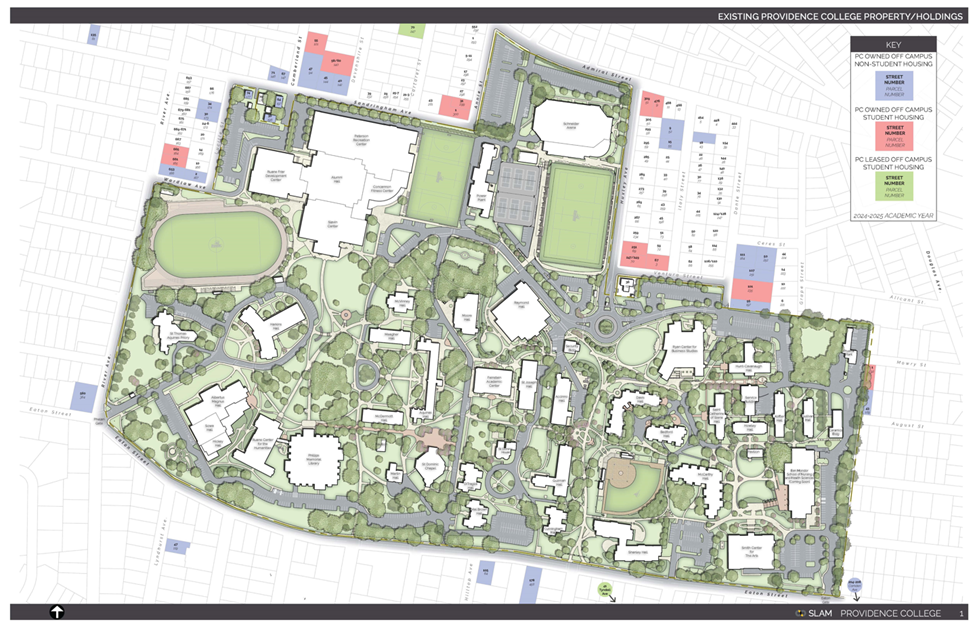
- Sexual exploitation is an act attempted or committed by a person for sexual gratification, financial gain, or other advancement through the abuse or exploitation of another person’s sexuality. Examples include, but are not limited to: non-consensual observation or photographing of individuals who are undressing or engaging in sexual acts; non-consensual use of electronic or other devices to make an audio or video record of sexual activity; prostituting another person; allowing others to observe a personal consensual sexual act without the prior knowledge and consent of all involved parties; and, knowingly exposing an individual to a sexually transmitted infection without their knowledge. ↩︎
- This Policy is not meant to be used as a mechanism for restricting or suppressing academic freedom. The higher-education academic setting necessarily accommodates themes, topics, material, and speech that are relevant to the subject matter and that, in other settings, may not be appropriate. The essential purposes of the academic setting are free intellectual pursuit and the free exchange of ideas. Wide-open debate helps to foster the search for truth, and in that search, we allow speech that might not be tolerated in other settings. Policies forbidding harassment and discrimination do not threaten academic freedoms. ↩︎
- See, for example, the College’sChild Abuse or Neglect Reporting Policy, which supersedes disclosure restrictions.
Additionally, Campus Security Authorities have a duty to disclose certain information to the Chief of the Office of Public Safety, who will maintain a Crime Log and statistics, and determine whether to issue a Timely Warning—Crime Alert to the community pursuant to the Jeanne Clery Act, as amended. ↩︎